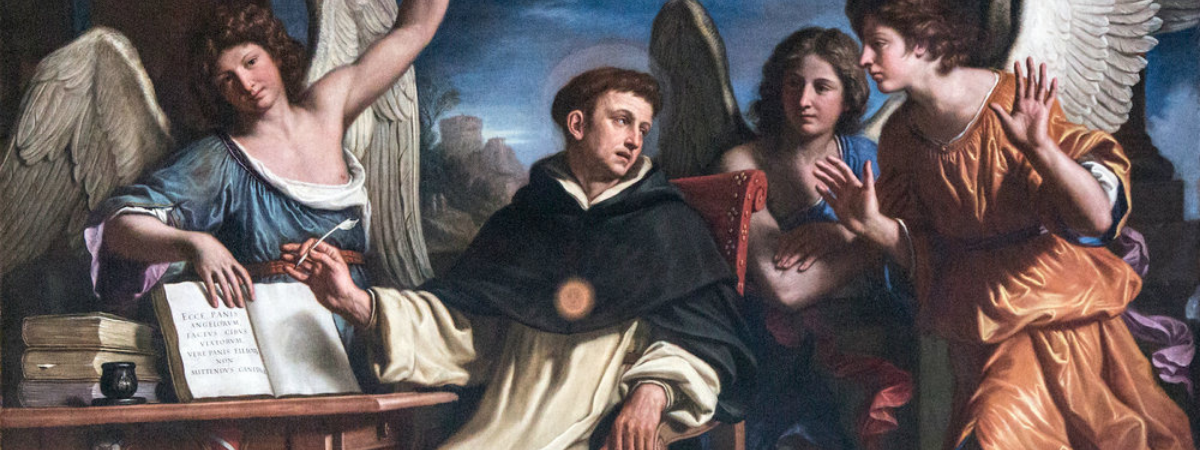
January 28 is the feast day of arguably the greatest intellect in the history of the Catholic Church, St. Thomas Aquinas, known as the Angelic Doctor due to his purity of mind and body and great intelligence. He gave up a life of nobility and wealth to be a poor Dominican friar, at the time a new religious order, much to the consternation of his family.
AQUINAS THE THEOLOGIAN
One biographer notes that prior to St. Thomas Aquinas' birth, a holy hermit prophesied to his mother about her unborn child:
"He will enter the Order of Friars Preachers, and so great will be his learning and sanctity that in his day no one will be found to equal him."
Unfortunately the prophecy didn't prevent St. Thomas' mother from having him locked up in a tower for nearly two years in an attempt to dissuade him from his chosen vocation to the Dominican order. They preferred him to be an esteemed Benedictine, and one day an influential abbot, not a begging mendicant friar. The hermit's prophecy eventually proved true, for St. Thomas prevailed against his family's intrigues and quickly surpassed the greatness even of his teacher, St. Albert the Great, who himself was called the "teacher of everything there is to know." St. Thomas Aquinas wrote copious volumes on theology and philosophy, even dictating his teaching to up to four secretaries at a single time.
Aquinas is now the foremost Doctor of the Catholic Church, and numerous popes have recommended the careful study of his works (especially in seminaries) the most notable of which is the Summa Theologica, a master compendium of Catholic faith and doctrine.
[[17242, 10651]]
AQUINAS THE MYSTIC
In addition to his brilliance, St. Thomas Aquinas was known for his holiness and sanctity. While he was locked away in the tower he overcame a planned assault on his purity, and consequently was given the grace of perpetual chastity of mind and body. These were the beginning of his numerous and profound mystical experiences, many of which had witnesses.
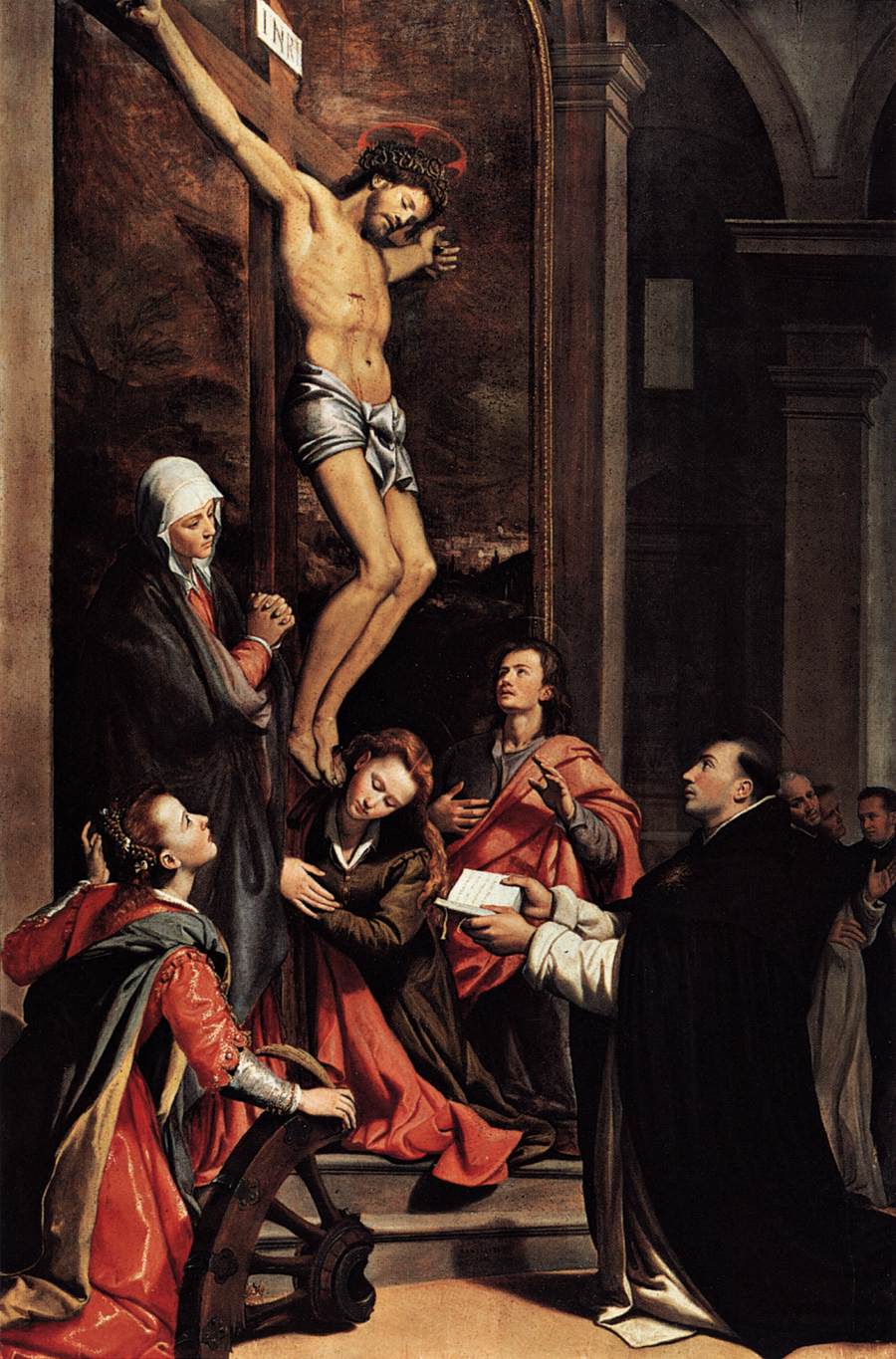
On one such occasion, after defending the doctrine of the Real Presence of Christ in the Eucharist following an academic dispute on the matter, St. Thomas laid his work before a crucifix and asked Christ to be the judge of its merits. All present heard a voice say in reply,
"Thou hast written well of the Sacrament of My Body, and thou hast well and truthfully answered the question that was put to thee, so far as it is possible to know these things on earth."
AQUINAS THE POET
The special grace of chastity that Aquinas received from God was the key to his profound theological insight. In line with his elucidation of the doctrine of the Real Presence of Jesus in the Blessed Sacrament, Aquinas was commissioned to compose the office for the feast of Corpus Christi. His most famous hymn is the Pange Lingua Gloriosi Corporis Mysterium, the last two stanzas of which are sung today in the Benediction following Eucharistic Adoration.
AQUINAS THE MASTER
Among the many Popes who have praised him are two of our recent popes. As said by Pope St. John Paul II and repeated by the Pope Benedict XVI,
“In his encyclical Fides et Ratio, my venerated predecessor, Pope John Paul II recalled that ‘the Church has been justified in consistently proposing St. Thomas a master of thought and a model of the right way to do theology’. It is not surprising that, after St. Augustine, among the writers mentioned in the Catechism of the Catholic Church, St. Thomas is quoted more than any other — some 61 times! He was also called the Doctor Angelicus, perhaps because of his virtues, in particular the loftiness of his thought and purity of life.
In short, Thomas Aquinas showed there is a natural harmony between Christian faith and reason. And this was the great work of Thomas, who in that moment of encounter between two cultures — that moment in which it seemed that faith should surrender before reason — showed that they go together, that what seemed to be reason incompatible with faith was not reason, and what seemed to be faith was not faith, in so far as it was opposed to true rationality; thus he created a new synthesis, which shaped the culture of the following centuries.”
St. Thomas Aquinas is truly one of the most influential saints of the Church, his work helping to define and articulate many Catholic doctrines in addition to harmonizing the faith with the natural light of human reason. Because of this, he is the patron saint of philosophers, theologians, apologists, scholars, students, schools, colleges and universities, learning and academics, and chastity. St. Thomas Aquinas, pray for us!
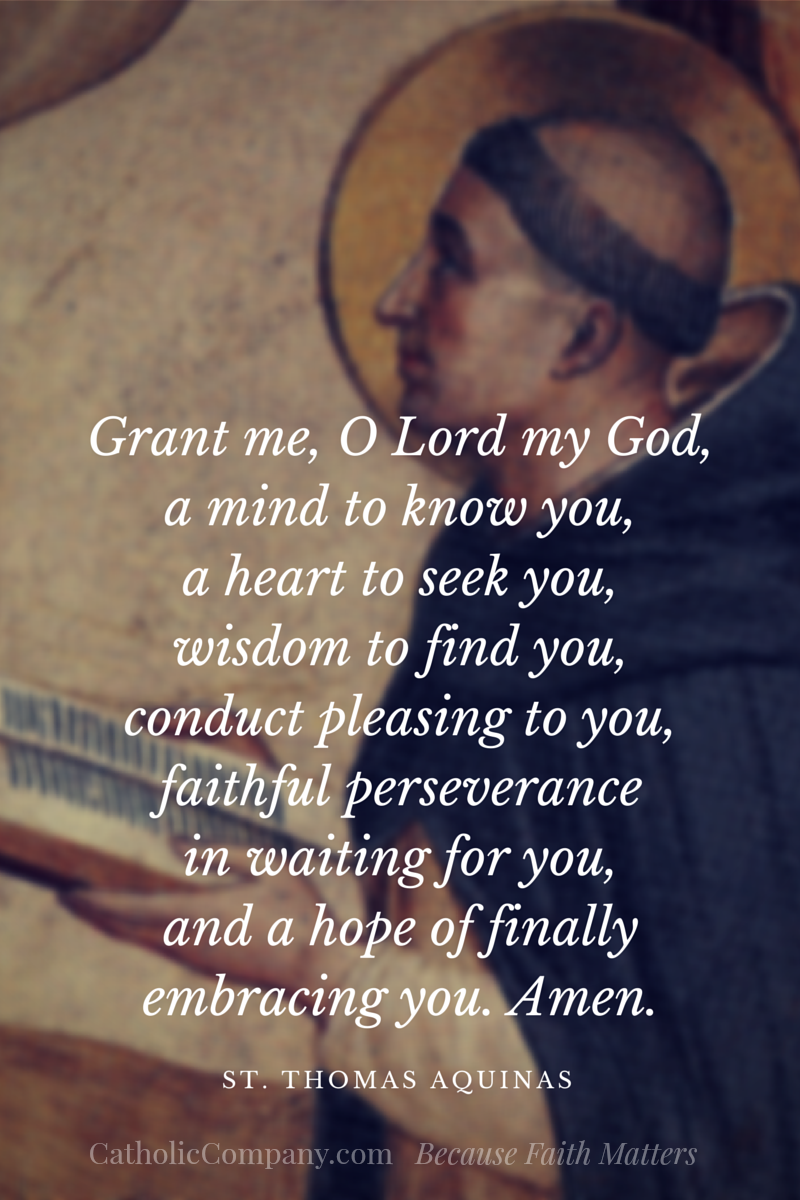
Prayer of Saint Thomas Aquinas
“Grant me, O Lord my God,
a mind to know you,
a heart to seek you,
wisdom to find you,
conduct pleasing to you,
faithful perseverance in waiting for you,
and a hope of finally embracing you."
Amen.
Read next Mary, Guide Me in the Way of Salvation: A Tender Prayer to Our Lady by St. Thomas Aquinas
This article has been updated and was originally published in January 2013. © The Catholic Company. All rights reserved.