Did the Spanish Inquisition really burn thousands of heretics at the stake?
Did it regularly issue draconian punishments to anyone who didn’t agree with the Church’s teachings?
Nope.
The notion that the Spanish Inquisition dealt out death sentences, torture, and cruel punishments to thousands of innocent, free-thinking heretics is traceable to a number of cultivated myths.
Near the end of the 16th century, northern European Protestants began a conscientious propaganda campaign against their enemies, the Spanish. It included much disinformation about a lot of things, including the supposed cruelties of the Spanish Inquisition.
These propagandized calumnies spread through Europe via pamphlets and books (with the newly-invented printing press speeding this process along) and were adopted by later enemies of the Church, as well. It was an anti-Spain, anti-Catholic historical thread that became known as the “Black Legend.” Much of the disinformation about the Spanish Inquisition has its roots in this “legend.”

Let’s do some research!
The actual number of heretics condemned to death by the Spanish Inquisition is small, because the Spanish Inquisition was a state institution, rather than a Church institution, and was at times abused by the monarchs (and excoriated by the Holy See for politicized sentences).
Furthermore, the Spanish Inquisition—reputed to be so severe—actually only condemned 1.8% of the accused to death in 130,000 heresy trials between 1478 and 1834 (that’s 356 years!) according to the meticulously researched book Vatican Secret Archives: Unknown Pages of Church History.
Another 1.7% were sentenced “in absentia” (the whereabouts of the accused being unknown, an effigy was burned in their place). But most of the defendants were acquitted or given punishments—most of which were spiritual—such as a penance or pilgrimage.
Vatican Secret Archives also notes that the Portuguese (whose Inquisition was actually more severe than Spain’s) received no such treatment in the press. The reason was that they were allies of the propagandists.
A case study in propaganda
One reason the Spanish Inquisition looms so large in popular imagination has less to do with history and more to do with politics.
In the sixteenth century, Spain was the dominant power in Europe. Its chief rivals, England and the Netherlands, had every incentive to portray Spain as cruel, fanatical, and oppressive. The Inquisition provided a convenient target.
With the rise of the printing press, anti-Spanish pamphlets, books, and illustrations spread rapidly throughout Europe. Graphic images depicted torture chambers, mass executions, and unspeakable atrocities. These accounts often painted Spain as uniquely brutal, helping build public support for political and military opposition to Spanish power.
Historians now refer to this sustained campaign as the "Black Legend."
This does not mean the Inquisition was perfect or that abuses never occurred. It does mean that many of the stories and numbers repeated for centuries were exaggerated for political purposes.
The irony is that other nations of the same period often imposed harsher penalties through their own courts. During the reign of Henry VIII, for example, tens of thousands of people were executed under English law, far exceeding the number of executions attributed to the Spanish Inquisition over its entire history.
None of this excuses the mistakes of the Inquisition. It does, however, remind us that history is often more complicated than the legends we inherit. The Spanish Inquisition became a symbol of Catholic cruelty in large part because Spain's political enemies found it useful to make it one. (Learn much more about this and other popular "legends" in our Good Catholic series, Faith vs. Fiction)
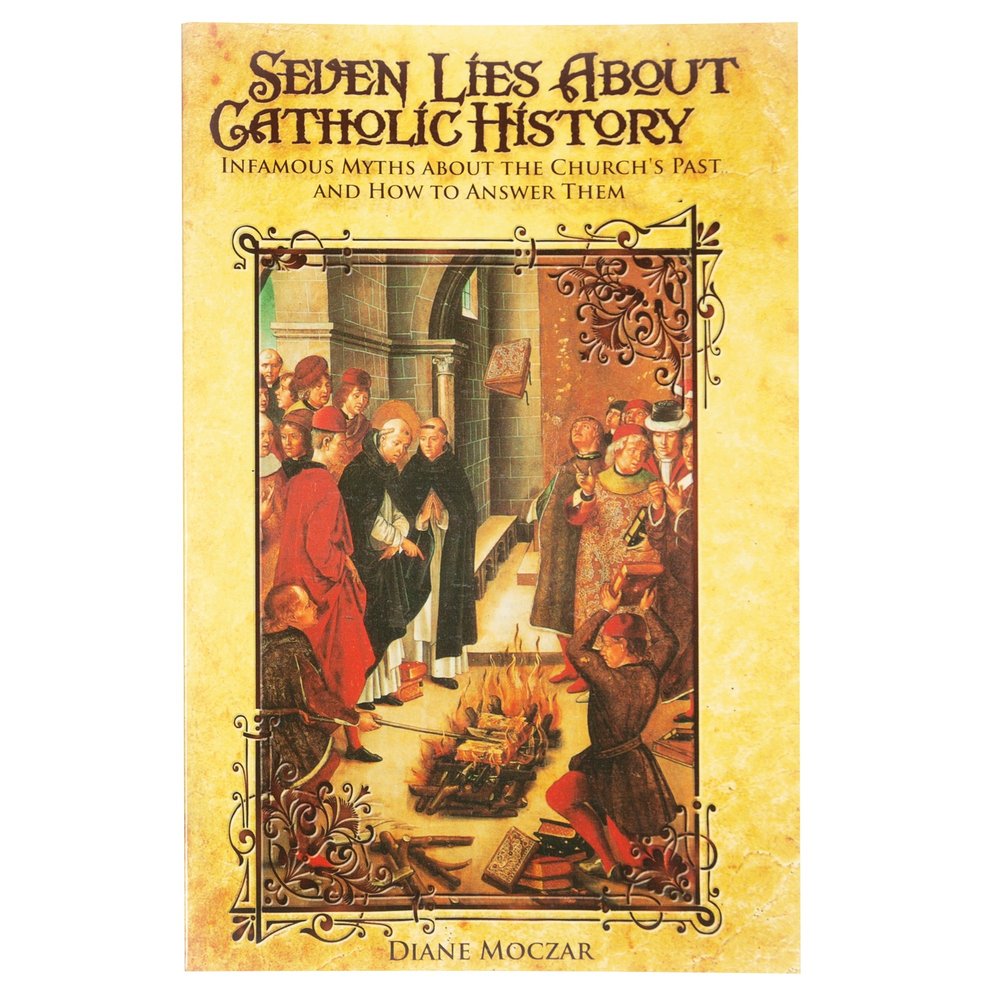
So: don’t believe everything you read on the internet. In Seven Lies about Catholic History, Diane Moczar tackles the most infamous and prevalent historical myths about the Church — popular legends that you encounter everywhere from textbooks to T.V. — and reveals the real truth about them. She explains how they got started and why they’re still around. Order your copy today from The Catholic Company!