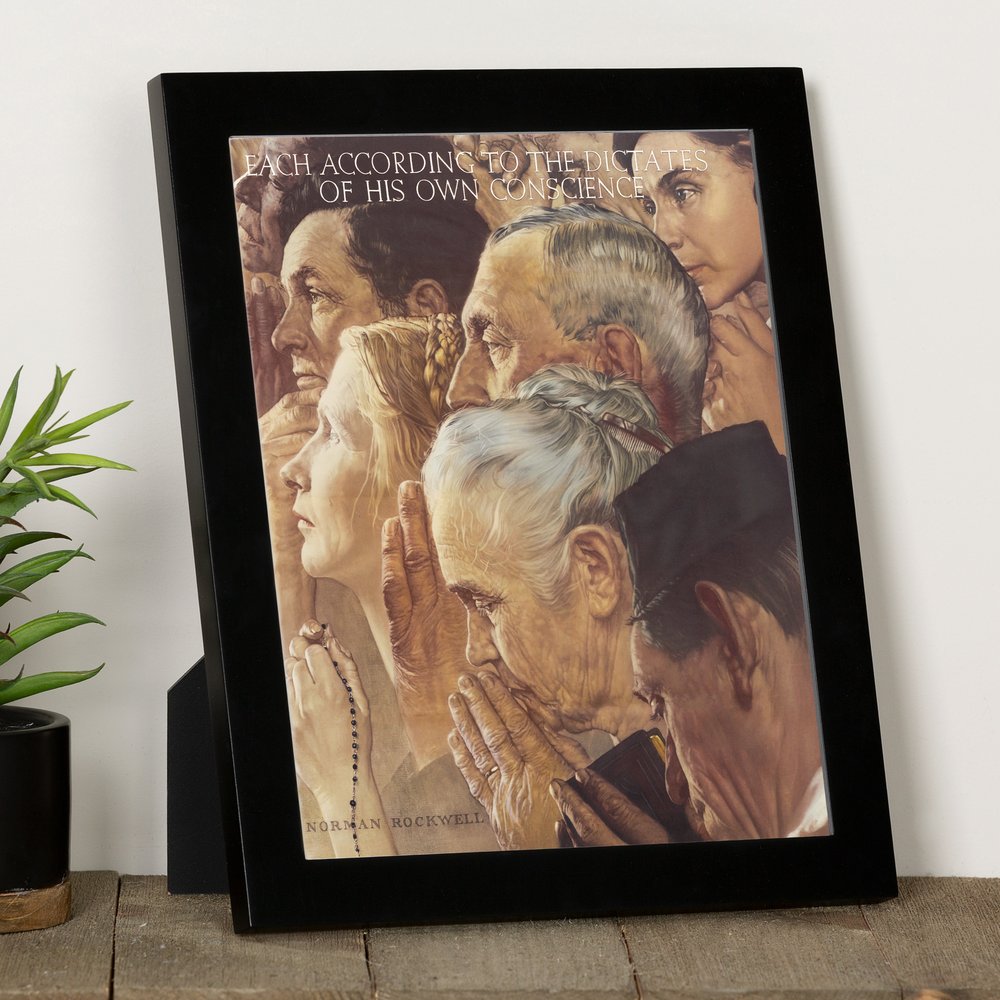



Norman Rockwell’s Freedom of Worship may be one of the most recognizable American paintings of the twentieth century, yet many people do not know the story behind it.
The painting was part of Rockwell’s famous “Four Freedoms” series, inspired by President Franklin Roosevelt’s 1941 speech describing four essential human freedoms worth defending during World War II. Among them was the freedom to worship God according to one’s conscience.
It is said that Rockwell struggled with how to portray that idea.
His early sketches were complicated and heavily symbolic, but nothing seemed convincing. Eventually, he abandoned large scenes altogether and focused instead on ordinary people at prayer. A woman holds a rosary. An elderly man bows his head. Others close their eyes in prayer. Across the top are the words: “Each according to the dictates of his own conscience.”

As Catholics, we can appreciate both the broader message of the painting and also the deeper reality beneath it. Religious liberty matters because worship matters. Human beings are made for God. The freedom to seek Him, pray, and live according to the truth is not simply a political ideal. It is tied to the dignity of the human person.
That understanding runs through Catholic history.
The early Christians worshipped in secret under the threat of persecution. Martyrs throughout the centuries died rather than offer worship to earthly powers in place of God. Even today, many Christians around the world still risk imprisonment, violence, or isolation simply for practicing the faith openly.
For Catholics especially, worship is never merely private sentiment. It is sacramental and embodied. We build churches. We kneel. We receive the Eucharist. We light candles. We ring bells. Worship shapes the whole person because it is directed toward the living God.
The Catholic presence within Rockwell's painting is unmistakable. The rosary beads held in prayer stand out immediately. It seems that Norman Rockwell knew that worship leaves visible marks on a culture and on the people themselves.
The painting also arrives at an important moment in American history. During World War II, freedom of worship was presented as one of the defining differences between free societies and totalitarian regimes. That remains relevant today. A society that forgets God eventually begins to forget the dignity of the human person as well.
At the same time, Catholics understand that freedom alone is not the highest good. Freedom exists so that we may seek and respond to truth. The Church has always taught that conscience must be formed rightly, not simply followed blindly. The goal is not merely the freedom to worship anything, but the freedom to worship God.
Perhaps that is part of why the painting still resonates decades later.
It reminds us that prayer is not weakness, nor is worship something outdated or private. It is one of the deepest expressions of what it means to be human. At The Catholic Company, we have honored Rockwell's Freedom of Worship with a beautiful gold frame or a simple black one. Find yours today at The Catholic Company!