














When Americans think of the Founding Fathers, the obvious names come to mind. Even among Catholics, Charles Carroll of Carrollton often receives the most attention as the only Catholic signer of the Declaration of Independence.
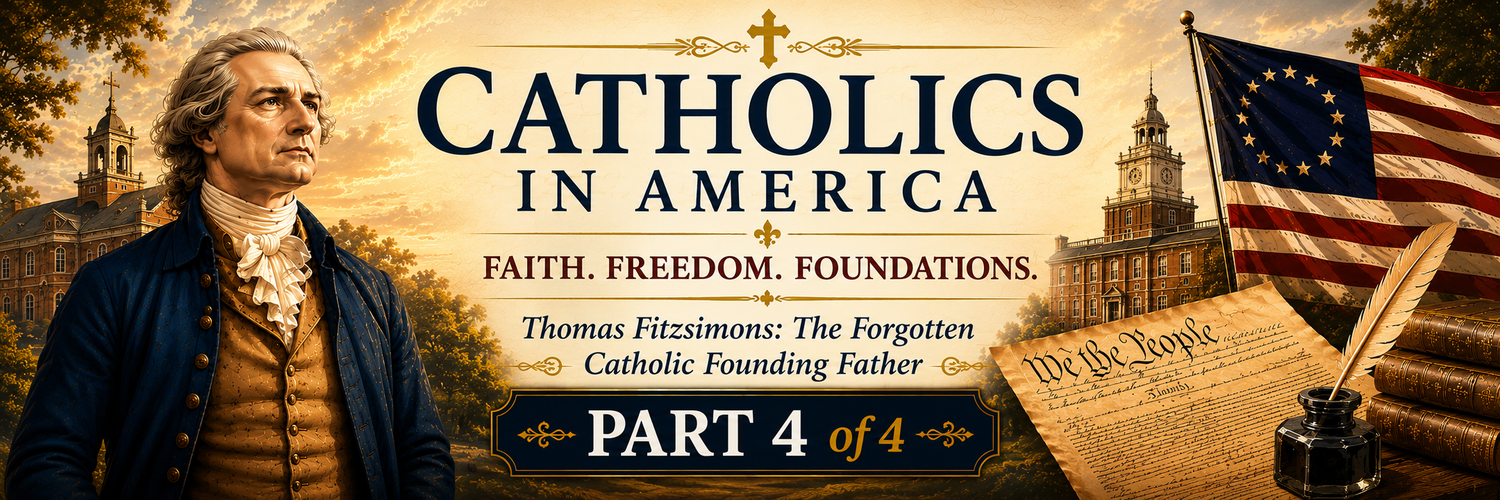
There was another Catholic who played a significant role in shaping the young republic: in its early days: Thomas Fitzsimons. He was one of only two Catholics to sign the United States Constitution.
As America prepares to celebrate its 250th anniversary, Fitzsimons deserves renewed recognition as a patriot, statesman, and faithful Catholic who helped build the foundations of our nation.
An Immigrant's American Story
Thomas Fitzsimons was born in Ireland around 1741 and immigrated to America with his family as a young boy. Settling in Philadelphia, he entered the mercantile trade and eventually became a successful businessman.
Like many immigrants who came to America seeking opportunity, Fitzsimons built a life through hard work, perseverance, and civic engagement. When tensions between Great Britain and the colonies escalated, he joined the Patriot cause and became active in Pennsylvania politics.
[[st-patrick-silver-plated-rosary,celtic-cross-home-blessing-cedar-trinket-dish]]
Serving the Cause of Independence
Fitzsimons did more than support independence from afar. During the Revolutionary War, he served in Pennsylvania's militia and contributed supplies and financial support to the American cause.
His leadership and practical experience earned him the respect of fellow patriots and helped establish his reputation as a capable public servant. Fitzsimons distinguished himself through steady service and a commitment to building effective institutions.
A Signer of the Constitution
Fitzsimons' most enduring contribution came in 1787 when he represented Pennsylvania at the Constitutional Convention in Philadelphia. There, delegates debated how to create a stronger national government while preserving the liberties for which the Revolution had been fought.
Many delegates came from traditions that historically distrusted Catholics, yet Fitzsimons was respected enough by his peers to help craft the governing framework of the nation.
When the Constitution was completed, Fitzsimons became one of two Catholic signers, along with Daniel Carroll of Maryland. These faithful men placed their names on the document that would become the supreme law of the land.
These two signatures represented more than personal achievements. They reflected the growing acceptance of Catholics as participants in American public life, something that would have been difficult to imagine in many parts of the English-speaking world only a generation earlier.
[[outdoor-metal-stars-stripes-cross-15,in-god-we-trust-canvas-tote]]
Building the New Republic
Fitzsimons continued serving the nation after the Constitution's ratification. He was elected to the First Congress of the United States, where he helped shape policies for the new federal government.
Drawing on his experience as a merchant, he became particularly involved in economic and financial matters that were critical to the nation's stability. His work helped establish confidence in the young republic during its earliest and most uncertain years.

A Quiet but Important Legacy
Unlike many founders, Thomas Fitzsimons did not leave behind dramatic speeches or a large body of writings. As a result, his contributions are often overlooked.
His life illustrates an important truth about the American founding: the nation was built not only by famous visionaries but also by dedicated citizens willing to serve the common good.
As an immigrant, businessman, patriot, Catholic, and signer of the Constitution, Fitzsimons embodied many of the qualities that helped shape the American experiment.
Remembering a Catholic Founder
The story of Thomas Fitzsimons reminds us that Catholics were not on the margins of America's founding. They were active participants in creating the institutions that continue to govern the nation today.
As America marks 250 years of independence, it is fitting to remember this often-forgotten founder whose faith, public service, and devotion to the common good helped strengthen the republic in its earliest days.
His story is less dramatic than the more famous founders or even than the wealthy & influential Carroll family, but more relatable. He represents the ordinary Catholic citizen who practiced his faith, raised a Catholic family, supported his parish, and faithfully served his country.
His name may not be as familiar as Washington or Jefferson, but his signature remains on one of the most important documents in American history, where he clearly made his mark and left an example for faithful Catholics and patriots.

Liberty's Lions: The Catholic Revolutionaries Who Established America