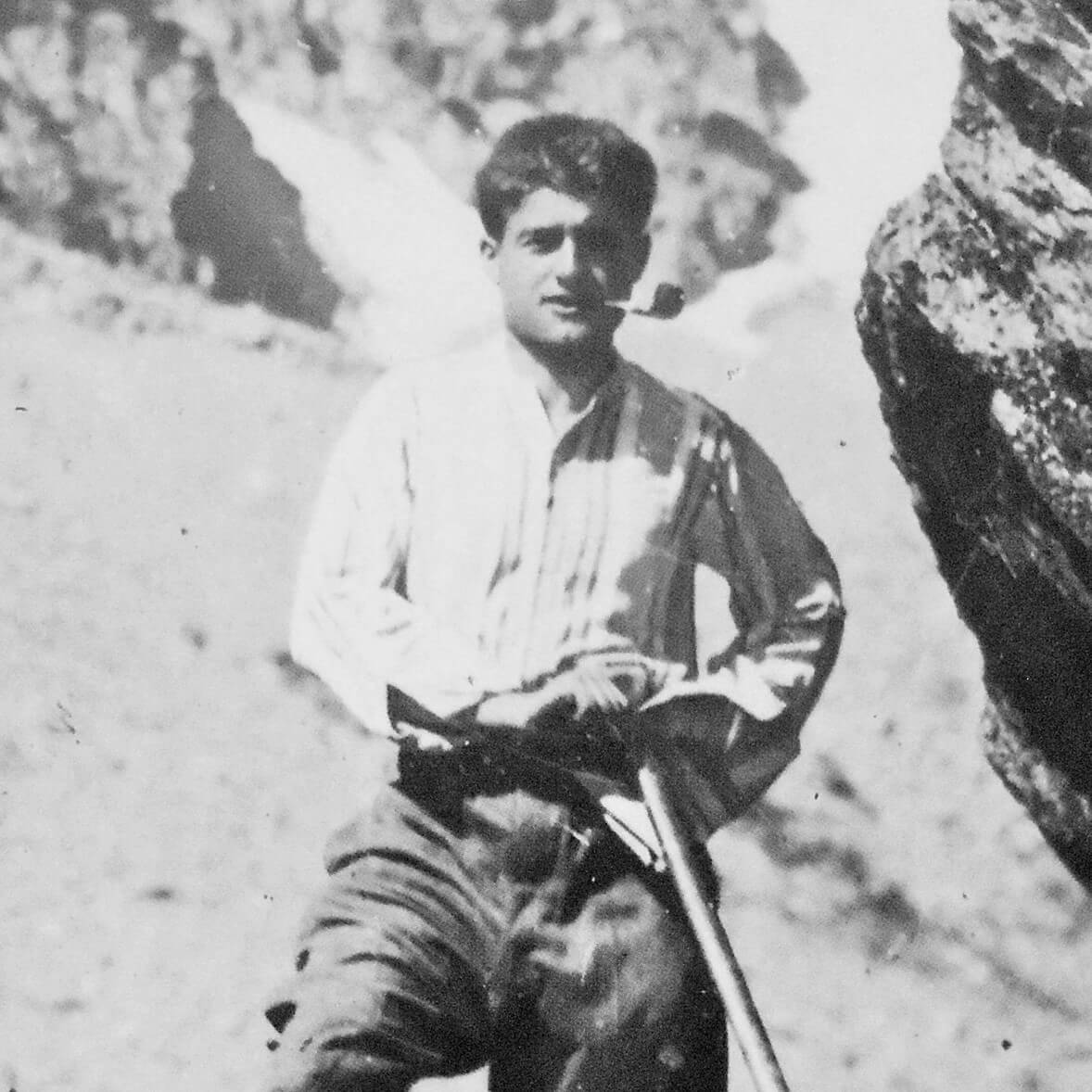
Pier Giorgio Frassati: Soon to Be Saint
“I exhort you in the words of my predecessor, Pius XII to be ‘docile to the lessons of the mountain... it is a lesson in spiritual elevation, of an energy which is more moral than physical.’”
— Pope St. John Paul II to the Delegates of the Italian Mountain Climbing Club, April 26, 1986
The young man’s body lay paralyzed in his bed, polio ravaging his strong frame that had scaled the highest peaks of the Italian Alps just months before. Every two hours throughout the night, he forced himself from his room, stumbling down the hallway to kneel beside his dying grandmother’s bed, where his family, consumed with grief over the elderly woman’s condition, barely noticed their son’s struggle. They thought he had the flu.
His mother would tell him: “You’re letting yourself go. If you want to get well, you must get hold of yourself.” (Luciana Frassati Gawronska, A Man of the Beatitudes: Pier Giorgio Frassati)
She could not have known that within forty-eight hours her son would be gone. On July 4, 1925, Pier Giorgio Frassati died at just twenty-four years old. His family, still reeling from the shock, assumed his funeral would be a quiet affair, attended by a few fellow engineering students and perhaps some political acquaintances of his father, the influential owner of Italy’s La Stampa newspaper.
But what they witnessed was something entirely unexpected. The streets of Turin filled not with the elite, but with hundreds of the city’s poor men, women, and children who wept openly for the young man they had known as a tireless friend. To the Frassati family, their son’s hidden life of service was suddenly revealed through the grief of those who had loved him most.
Only then did the hidden reality of his life come to light.
On September 7, 2025, Blessed Pier Giorgio Frassati will be canonized alongside Blessed Carlo Acutis by Pope Leo XIV. It’s time to learn his story.
The Man of the Beatitudes
Unlike some saints whose paths to holiness were marked by dramatic conversions from sin, Pier Giorgio Frassati’s journey was different. Born on Holy Saturday, April 6, 1901, in Turin, Italy, he seemed destined for sanctity from the beginning. Yet this made his story no less compelling; for his was a holiness hidden in plain sight, a radical love disguised as ordinary life.
Saint John Paul II, who beatified Frassati in 1990, called him the “Man of the Eight Beatitudes.” The Polish Pope, himself an avid mountaineer, understood something profound about this young Italian who had scaled the peaks of the Alps with the same passion he brought to serving the poor.
“The way Jesus shows you is not easy. Rather, it is like a path winding up a mountain. Do not lose heart! The steeper the road, the faster it rises towards ever higher peaks.” – Pope St. John Paul II
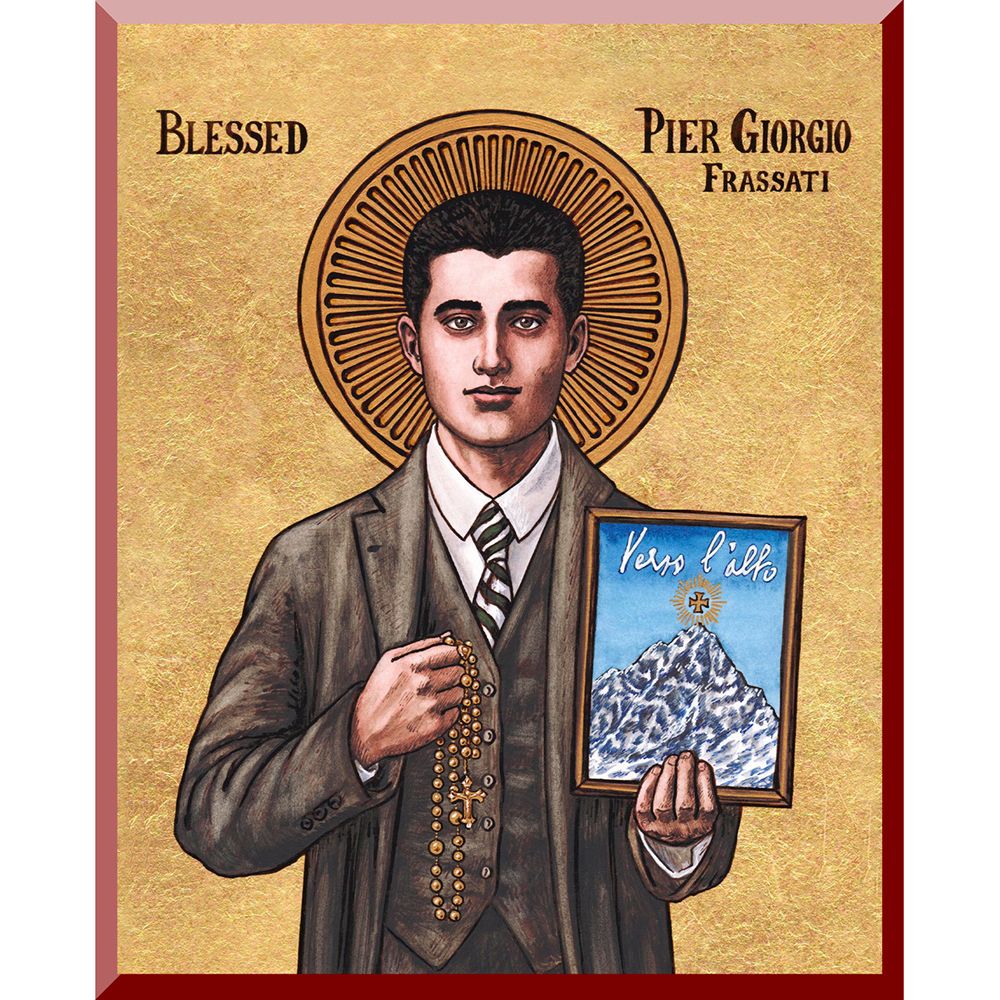
Frassati lived this truth literally and figuratively. His motto, Verso l’alto!—“To the heights!”—referred not only to his conquest of peaks like Monte Viso and Grand Tournalin but also to his relentless pursuit of holiness. As he once wrote to a friend: “The higher we go, the better we shall hear the voice of Christ.”
But here was the paradox that made Pier Giorgio extraordinary: the higher he climbed toward God, the lower he descended to serve humanity. For him, the mountains were not an escape from mission but a preparation for it. The same strength that carried him up the mountainside carried him down into the slums of Turin, where he would kneel beside the sick, comfort the dying, and give away his own possessions to the poor.
John Paul II once wrote: “For these mountains awake in our hearts the sense of the infinite with the desire to raise up our minds to what is sublime. It is the Author of Beauty Himself… We can pray perfectly when we are out in the mountains or on a lake and we feel at one with nature. Nature speaks for us or rather speaks to us.” (From A Catholic Perspective: Physical Exercise and Sports).
Between Heaven and Earth: A House Divided
According to Pier Giorgio’s sister, Luciana Frassati Gawronska (author of A Man of the Beatitudes: Pier Giorgio Frassati), the Frassati household was a study in contrasts that would shape the future saint’s character in ways his parents never intended.
Pier Giorgio Michelangelo Frassati was born into privilege, the son of an agnostic father and a Catholic mother. His father, Alfredo Frassati, was a man of immense worldly success: founder and owner of La Stampa, senator, and later ambassador to Germany. His mother, Adelaide Ametis, was a gifted painter whose works had been exhibited in Venice and purchased by King Victor Emmanuel III. She was Catholic, but not with the fervor that would later characterize her son.
Luciana describes her parents’ marriage as one of social compatibility rather than spiritual unity. From Pier Giorgio’s earliest years, he navigated two worlds: his father’s realm of secular achievement and his mother’s nominal faith. The discord created an environment where, as Luciana later wrote, “no one fully knew or understood Pier Giorgio, and they never guessed where he actually went.”
The first signs of his extraordinary compassion appeared in childhood. When a poor woman came begging with her shoeless son, Pier Giorgio immediately gave the boy his own shoes. When his father refused to help a drunk man seeking assistance, young Pier Giorgio wept until his mother allowed him to bring the man home for a meal.
His parents, however, misunderstood his growing devotion. His daily Mass attendance, his participation in Catholic organizations, and his obvious piety troubled them. They feared he might become a priest, abandoning the worldly success they expected. Alfredo, especially, could not understand why a young man blessed with intelligence, wealth, and social position would not want to follow in his footsteps.
But while his family remained largely blind to it, Pier Giorgio’s hidden sanctity was quietly taking root.
The Hidden Saint
In 1918, Pier Giorgio joined a Saint Vincent de Paul conference and began spending much of his time helping the poor. He chose engineering not out of career ambition but because he wanted to become a mining engineer “to serve Christ better among the miners.”
When his father offered him either a car or a fund upon graduation, he chose the money—to give it to the poor. He provided a bed for a tuberculosis sufferer, supported the three children of an ill widow, and found housing for an evicted woman.
“We were still unaware, at his death watch, that he had been late for mealtimes because he had given his tram money to some poor person and his jacket to another.” (Luciana Frassati, A Man of the Beatitudes)
Pier Giorgio also embraced Catholic Action and the Third Order of St. Dominic, inspired by saints like Thomas Aquinas and Catherine of Siena. He spoke often of St. Paul in his letters, finding in the apostle’s zeal a model for his own life.
His friends called him “an explosion of joy”—he whistled and sang loudly and out of tune, loved playful teasing, and was known as “the Terror” for his practical jokes. Yet beneath the laughter was a hidden discipline of prayer, sacrifice, and service.
Verso l’Alto: To the Heights
Pier Giorgio’s family worried about his religious devotion and academic struggles, but they could appreciate his passion for mountaineering. He was a member of the Italian Alpine Club and had successfully climbed some of the most challenging peaks in the Alps, often leading groups of friends up difficult routes.
But for Pier Giorgio, climbing was never just sport. It seemed it was a way of reaching for God, of living his motto Verso l’alto! It seemed he had the same sense as Pope John Paul II - that every summit gives us strength to return to the valley. That was where Pier Giorgio's true vocation awaited in service to the poor.
In honor of Blessed Pier Giorgio, the Italian Alpine Club later dedicated mountain trails to him in each of Italy’s twenty regions, creating a network that carries forward his motto: Verso l’alto!
The Final Ascent
On June 30, 1925, while boating with friends on the Po River, Pier Giorgio began to complain of sharp pains in his back. At first it seemed minor, but within days he grew feverish and weak. At the same time, his grandmother was gravely ill, and the household’s attention was fixed on her. Pier Giorgio, not wanting to trouble anyone, continued to pray at her bedside even as paralysis from polio set in.
By July 2, when a doctor finally examined him, his condition was clear: poliomyelitis was destroying his nervous system. The young man who had once conquered the Alps could no longer rise from his bed. His final words were a prayer: “May I breathe forth my soul in peace with you.”
Pier Giorgio died on July 4, 1925, at the age of twenty-four. The strong body that had carried him to the heights was brought low by the very illness he had risked in serving the poor. Yet death did not have the final word.
[[the-frassati-field-guide,st-pier-giorgio-frassati-adventure-t-shirt]]
A Saint for Our Time
Pier Giorgio’s cause for canonization opened in 1932, driven not by bishops or politicians but by the poor of Turin. In 1990, John Paul II beatified him, calling him “the Man of the Eight Beatitudes.” In 2024, Pope Francis approved the miracle needed for canonization.
And on September 7, 2025, Pier Giorgio Frassati was declared a saint alongside Blessed Carlo Acutis by Pope Leo XIV.
In an age when young people are often portrayed as selfish or disconnected from faith, the Church has lifted up two examples of radiant joy, generosity, and holiness: Pier Giorgio Frassati and Carlo Acutis. Frassati in particular reminds us that sanctity is often hidden in ordinary life and revealed not in grand gestures but in steady acts of love.
The young man who climbed mountains also served the poor; he lived in privilege but found his joy among the suffering; he died at twenty-four but lived his short life in heroic holiness.
Pier Giorgio reminds us that the path to heaven is steep and demanding, but every step upward brings us closer to the One who is our destination.
This saint calls us to our own ascent.
Let us begin the climb. Verso l’alto!