








I recently heard a homily from a deacon at a church I don't attend regularly, but it was one of those moments where you feel like the priest or deacon is speaking directly to you. The words land with a particular weight, and you know they are something you are supposed to hear.
So I began to jot down notes.
Deacon Joe (Becker) at St. Matthew in Charlotte was preaching on the way the Church selects our Sunday readings, and he pointed out something beautiful. “On all but a few Sundays,” he said, “the first reading points to the Gospel - it has a similar theme that is revealed or fulfilled in the gospel. And if you are wondering what the connection is, the Responsorial Psalm tells you.”
That day, the Responsorial Psalm was, “Our help is in the name of the Lord.” Deacon Joe explained that this bridge connects us to the God who made the heavens and the earth, the majestic God who placed each star. He reminded us that this same God isn’t distant; He is an intimate God who “loves you and me and cares about the smallest details of our lives.”
That’s where it started to hit close to home. Because, as the Deacon pointed out, I sometimes project my own limitations onto God. I know He is all-powerful, but I don’t always pray like it. As he put it, “It’s easy at times for us to pray with him as if he has limits too.”
I know that I often do this. I come to God with my needs and my petitions, but my requests are shaped by what I think is possible.
Do we really trust God?
If I’m honest with myself, I don’t always fully trust God. I question whether He could really do something, especially when it seems impossible from my limited perspective.
Deacon Joe then used an image that has been seared into my mind ever since:
“Picture a small child leaning into an overwhelming, overflowing waterfall - holding out a very small cup. He is receiving a tiny amount of the water flowing. That’s us so often. It's when we come to him with such limited requests - such a small ask - but like the child, you and I can ask so little of Him because we are limited in what we think is possible with God.”
That’s me. I am that child holding the tiny cup. I ask God to change a circumstance or provide for a specific need, but my ask is often small, confined by what I can understand or imagine. I pray, but I’m simultaneously hedging my bets, afraid to hope for too much.
Deacon Joe went on to say: "It's like we can imagine this box of all the possible things that God could do for us, and we come to him with our requests from the box. But He is not bound by the box. His infinite capacity is so much more than we can imagine. More than we can hope for. He is God. He can do anything."
 Scripture tells us in many places to put our trust in God. Proverbs is just one example. : "Trust in the Lord with all your heart, and do not rely on your own understanding. In all your ways acknowledge Him, and He will make straight your paths." (Proverbs 3:5-6).
And yet, perhaps we are afraid of the cost of what we might ask.
This makes me think of a quote from C.S. Lewis: “We are not necessarily doubting that God will do the best for us; we are wondering how painful the best will turn out to be.” That fear of the unknown, of a plan that is not my own, keeps my cup small.
God desires for us more than we know how to ask for
The Deacon’s message in his homily wasn’t one of condemnation; it was an invitation. He reminded us that God’s vision for us is one of abundance. “He envisions an abundance of grace for us. He so wants us to share in his incredible peace, to experience his deep joy. His desire is that we open ourselves to the abundance of what he so wants to give us.”
This is the paradox so many of us live in. We are like the father in the Gospel who cries out, “Lord, I believe; help my unbelief!” (Mark 9:24). We believe in an infinite God, but we approach Him with finite requests. We long for His will, but we’re afraid of what it might cost us.
So what do we do? How do we put down the little cup?
Deacon Joe's final question hangs in the air: “Are we willing to expand our hearts, open our minds to what he offers and wants for us?”
It's a bit scary for me to contemplate this question because it begins with acknowledging my limited trust. It means asking for the grace to desire more of Him than I do of my own plans.
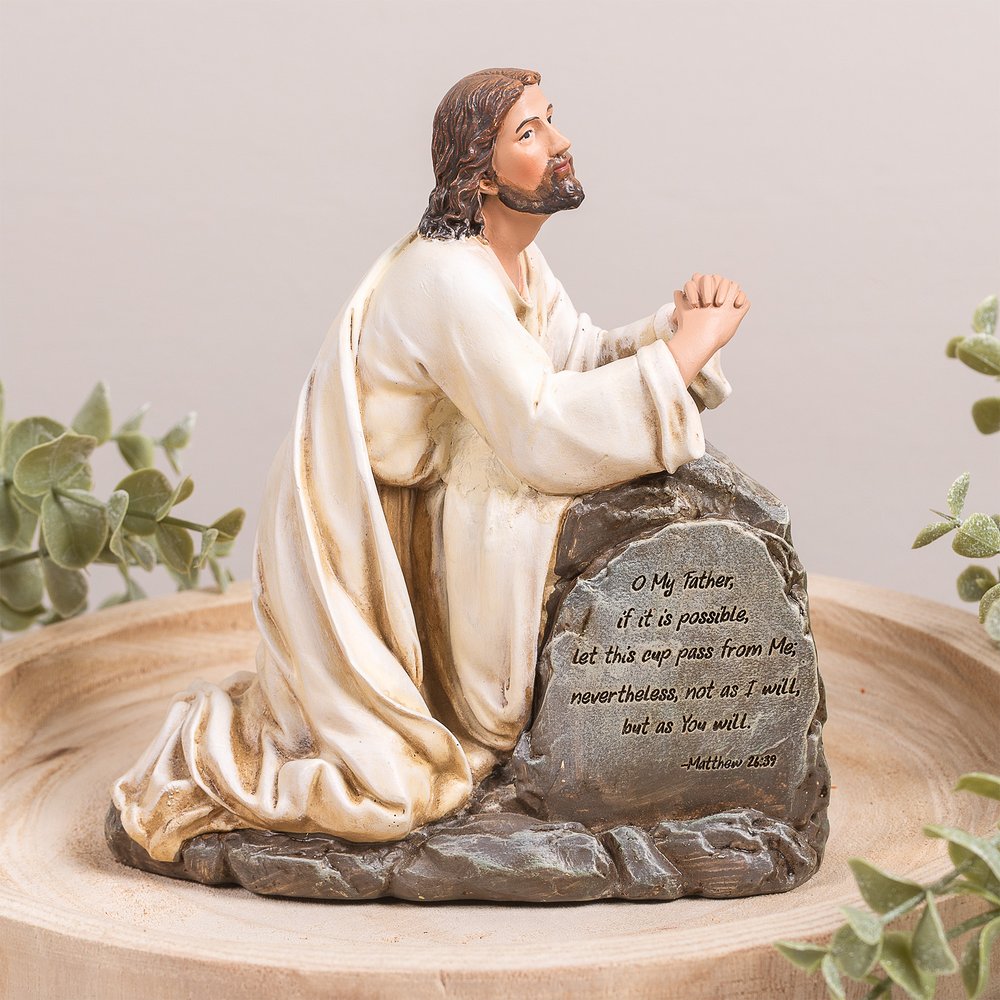
I recall a prayer we were encouraged to consider during a women's retreat I once attended: “Lord, help me to want what You want.”
God is the Creator and we are His creatures
The Deacon's question also brings us to the truth of who God is. He is the Creator of the universe. And to the truth of who we are. Many saints speak about the essential self-knowledge that ultimately allows us to recognize God's sovereignty. St. Catherine of Siena, when she asked God who He was and who she was, heard God say to her, 'I am who is, you are she who is not'. This is the reality we so often forget: He is infinite, and we are finite. Yet we pray as though our small cup is all He has to offer.
I am certain I am not alone in my struggle to trust God. Yet while we might understand that trustful surrender is a lifelong pursuit, we must begin now.
“If, devout soul, it is your will to please God and live a life of serenity in this world,” said St. Alphonsus Liguori, “unite yourself always and in all things to the divine will.”
This is not as easy as it may sound.
"It requires an active trust in God's goodness and a certain distrust of our own desires and wills. To intentionally will what God wills for us chips away at our obstinacy and allows us to be at peace with whatever God sends us" (Thy Will Be Done, Good Catholic series).
Ah, that's the rub. True peace requires a complete renunciation of self-will and a profound trust in the omnipotence of God and in His providential care.
We can remember that God doesn't ask us to do this without providing for us the means. We need to lean on Him. He gives us the graces through the efficacious sacraments of the Church, especially the Holy Eucharist and Confession.
I am grateful to Deacon Joe for introducing me to this image of the little cup in comparison to the inexhaustible graces of God. Even now, as I write this, I know that I will continue to struggle with trustful surrender. But as Padre Pio said: “Be content to progress in slow steps until you have legs to run and wings with which to fly.”

Maybe the first slow step is admitting how small my cup is, and asking Him for the courage to throw it away; to stand before Him empty-handed, ready to receive whatever He desires to pour out.
Want to learn more about trustful surrender? Discover the acclaimed Good Catholic series, Thy Will Be Done.