This short reflection is drawn in part from The Spiritual Exercises of St. Ignatius of Loyola. This classic of Christian spirituality offers a profound guide to prayer, discernment, and the application of the senses. We highly recommend it to anyone seeking to deepen their prayer life and to encounter Christ more personally.
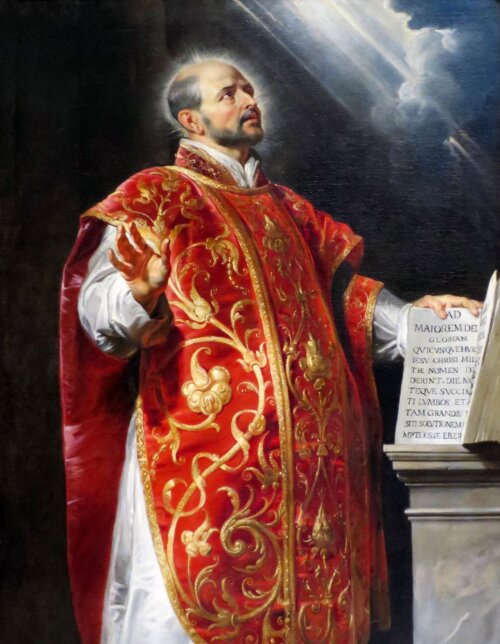
"No matter how much you love the Blessed Virgin Mary, She will always love you much more than you love Her." -St. Ignatius of Loyola
From the beginning, the Rosary has been more than just a Marian devotion. It is a pathway to Christ. Mary’s greatest desire is to lead us to her Son, and many saints have described her as the moon reflecting the light of the sun. Just as the moon reflects the brilliance of the sun in a way that does not harm our eyes, Mary reflects the radiance of Christ in a way we can safely contemplate. Through her, we glimpse God’s love shining into the world.
The Rosary: Marian and Christ-Centered
When we pray the Rosary, we place ourselves at Mary’s side and meditate on the mysteries of her Son. As St. John Paul II wrote in Rosarium Virginis Mariae:
“The Rosary, though clearly Marian in character, is at heart a Christocentric prayer… With the Rosary, the Christian people sits at the school of Mary and is led to contemplate the beauty on the face of Christ and to experience the depths of his love.”
The Rosary, then, is not simply a repetition of prayers but an immersion into the Gospel. Mary teaches us to “read” Christ through the mysteries, uncovering His message and encountering His love.
The Role of the Imagination in Prayer
To engage with these mysteries more deeply, we need more than passive recitation. St. Ignatius of Loyola offered a method that helps us enter into the Gospel personally: the “application of the senses.”
This approach invites us to use our imagination to place ourselves within a scene of Christ’s life. Instead of trying to silence every thought, we direct our senses—sight, hearing, touch, even taste and smell—toward the mystery before us.
St. Ignatius explained in his Spiritual Exercises:
“By the imagination, the soul can render an object present and, as it were, see it, hear it, taste it, and so on… to apply this faculty of the soul and the five senses to a truth of religion…or to a mystery of Our Lord Jesus Christ, is what is called application of the senses.”
He even suggested focusing on one person within the mystery and paying special attention to them. He outlined a process for prayer:
-
See the persons, places, and circumstances.
-
Hear their words or imagine what they might say.
-
Taste interiorly the sweetness or bitterness of the moment.
-
Smell the fragrance of virtues—or the corruption of sin.
-
Touch spiritually: the manger, Christ’s garments, His wounds.
This way of praying allows us to experience Christ’s life as something real and tangible.
Encountering Christ in Our Lives
When we apply this method to the Rosary, the mysteries cease to be distant events of long ago. They become encounters with the living Christ who still moves in our lives today. As Pope Leo XIII beautifully wrote in Fidentem Piumque Animum:
“As the various mysteries present themselves one after the other in the formula of the Rosary for the meditation and contemplation of men’s minds, they also elucidate what we owe to Mary for our reconciliation and salvation… Now Christ stands forth clearly in the rosary. We behold in meditation His life, whether His hidden life in joy, or His public life in excessive toil and sufferings unto death, or His glorious life from His triumphant resurrection to His eternal enthronement at the right hand of the Father.”
Through such meditative prayer, we not only see Christ more clearly—we also begin to see our own lives in His light. This enables us to discern His will and to walk more faithfully as His disciples.
Discover our extensive collection of Rosaries here.