


“What tongue, human or angelic, may ever describe a power so immeasurable as that exercised by the simplest priest in the Mass? And who could ever have imagined that the voice of man, which by nature hath not the power even to raise a straw from the ground, should obtain through grace a power to stupendous as to bring from Heaven to earth the Son of God?”
St. Leonard of Port Maurice
Yesterday we saw how each part of the Mass is a particular invitation into God’s love. Today and tomorrow we will learn about the roles of individual persons within the Mass, namely, the priest and the congregation.
We will begin with the priest, and see how his office is intrinsic to the celebration of Holy Mass. The priest fulfills a necessary duty within this holy sacrifice, connecting us directly to the person of Jesus Christ. Without the priest, there would be no Mass; without the priest, there would be no Eucharist.
Sacrifice Requires a Priest
Just as God provided sacrifice as a means for us to be separated from our sin, He instituted the priesthood in order to truly redeem us from our sin through the one-time sacrifice of Jesus Christ. The priest is an essential part of the sacrifice. One cannot exist without the other.
In the words of Monsignor George Moorman, priest and catechist:
He who sacrifices is called a priest; the sensible [i.e. tangible] thing which is sacrificed is called the victim; the place where it is sacrificed is the altar; These four—priest, victim, altar, and sacrifice—are inseparable. Each one of them calls for the others.
First and foremost, a priest is someone who offers sacrifice to God. Sacrifice defines the office of the priesthood, and always has. In the Old Testament, God ordained a particular priesthood to carry out sacrifice for His people; first with Melchizedek, and later with Aaron and the Levites under the Mosaic Law. In the fullness of time, Jesus Christ perfected the office of the priesthood and gave it to His Church in the New Covenant.
Scripture tells us:
Every high priest is taken from among men and made their representative before God, to offer gifts and sacrifices for sins. He is able to deal patiently with the ignorant and erring, for he himself is beset by weakness and so, for this reason, must make sin offerings for himself as well as for the people. No one takes this honor upon himself but only when called by God, just as Aaron was. In the same way, it was not Christ who glorified himself in becoming high priest, but rather the one who said to him:
** ‘You are my son; this day I have begotten you”;**
just as he says in another place:
** ‘You are a priest forever according to the order of Melchizedek.’**
In the days when he was in the flesh, he offered prayers and supplications with loud cries and tears to the one who was able to save him from death, and he was heard because of his reverence…he became the source of eternal salvation for all who obey him, declared by God high priest according to the order of Melchizedek.

The Priesthood of the New Covenant
In a certain sense, all Christians are called to offer sacrifice to God throughout our lives, presenting our burdens and suffering to God in atonement for our sins. The Catechism calls this our “baptismal priesthood,” because it is shared by all baptized persons.
However, just as the Holy Sacrifice of the Mass is a specific and sacramental sacrifice, so too is the Catholic priesthood set apart as a specific and sacramental office. This distinction is manifested by Christ through the Sacrament of Holy Orders.
The Catechism explains:
The ordained ministry or ministerial priesthood is at the service of the baptismal priesthood. The ordained priesthood guarantees that it really is Christ who acts in the sacraments through the Holy Spirit for the Church. The saving mission entrusted by the Father to his incarnate Son was committed to the apostles and through them to their successors…
The ordained minister is the sacramental bond that ties the liturgical action to what the apostles said and did and, through them, to the words and actions of Christ, the source and foundation of the sacraments.
Jesus Christ is the link between humanity and the divine—the priesthood is our link to Christ. Just as God required the people of Israel to have a dedicated priesthood whose members offered sacrifice under the Old Law, so too has God given us a dedicated priesthood under the New Law.
In Persona Christi Capitis
The Holy Mass is the most important duty of a priest, because it is the sacrifice by which we are saved. When a priest offers the Mass, he does so in persona Christi Capitis, that is, he acts in the person of Christ the Head of the Church. Through the power given to the Apostles, the priest shares in the eternal high priesthood of Jesus Christ.
In the Mass—indeed, in all the Sacraments—it is Christ Himself who acts and imparts grace. Our Lord is made manifest through the priest, who acts “in the person of Christ.” His hands are the hands of Christ, elevating the Host. His voice the voice of Christ, saying, “This is my body, which will be given up for you.”
The priest is like a sacred vessel, receiving the rites and rubrics of the Holy Mass, and administering them to the Faithful. In fact, the priest is the only person at Mass who is truly indispensable to the liturgy; the Mass cannot happen without him. Simultaneously, his office gives him the grave responsibility to bring the Mass to the Church faithfully and unaltered. He cannot change the rubrics of the liturgy for any reason.
The Catechism clearly states:
Liturgy is a constitutive element of the holy and living Tradition. For this reason no sacramental rite may be modified or manipulated at the will of the minister or the community. Even the supreme authority in the Church may not change the liturgy arbitrarily, but only in the obedience of faith and with religious respect for the mystery of the liturgy.
Vatican II said likewise: “…no other person [except supreme Church authority], even if he be a priest, may add, remove, or change anything in the liturgy on his own authority” (Sacrosanctum Concilium).
Rather, priests are ordained ministers who are entrusted with faithfully bringing the sacrifice of the Holy Mass, and all the Sacraments, to the laity.
What If the Priest Is Sinful?
Priests are human. Like all of us, they may make mistakes and errors, exhibit poor judgment, and even fall into grave sin. This naturally raises the question: what happens to the sacrament if the priest is in a state of mortal sin?
Thankfully, the graces of the Mass do not depend upon the righteousness of the priest. All the Sacraments act ex opere operato, meaning they act “from the work which is being worked.”
This means that the graces of the Sacraments come from God alone, and are efficacious by virtue of the power of the Sacraments themselves regardless of the holiness of the priest. For instance, during the Mass, the priest is not turning the bread and wine into the Body and Blood of Christ by his own power; God does that through the priest, who is His channel and instrument.
St. Teresa of Avila, the great mystic and Doctor of the Church, once recounted a harrowing vision, in which God revealed to her the almost-terrifying responsibility of the priestly office:
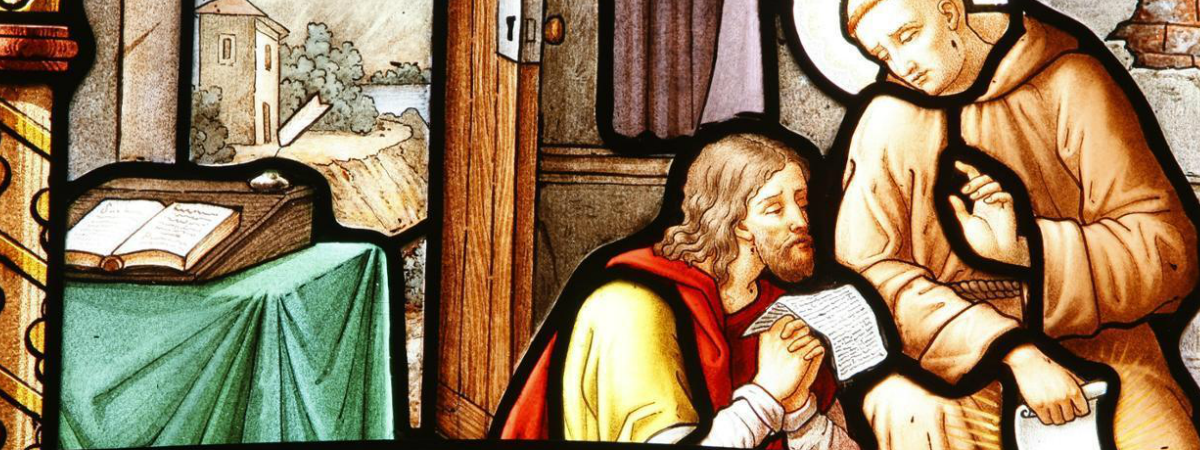
Once when I was going to Communion, I saw with the eyes of the soul, more distinctly than with those of the body, two demons of most hideous shape. Their horns seemed to encompass the throat of the poor priest. I beheld my Lord, in that great majesty of which I have spoken, held in the hands of that priest, in the Host he was about to give me.
It was plain that the hands were those of a sinner, and I felt that the soul of that priest was in mortal sin…The two demons were so frightened and intimidated in Your presence that they seemed as if they would have willingly run away, had You but given them permission.
I was so troubled by the vision that I don’t know how I was able to receive Holy Communion. I was also in great fear…Our Lord Himself told me to pray for that priest. He said He had allowed this vision so I might understand the power of the words of consecration and how God didn’t fail to be truly present in the Host, no matter how wicked the priest might be who uttered those words. He also wanted me to see His great goodness in that He places Himself in the very hands of His enemy, for my good and for the good of all.
I understood clearly how the priests are under greater obligation to be holy than other persons and what a horrible thing it is to receive this most Holy Sacrament unworthily; how great is the Devil’s dominion over a soul in mortal sin.
We should be thankful to Our Lord for not depriving us of Himself even when there are unholy priests.
We should also be thankful to Our Lord for bestowing upon priests such a great power as the Holy Sacrifice of the Mass, for it is only through their priestly office that we can receive the Body of Christ.
Priests have received from God a power that he has given neither to angels nor to archangels…God above confirms what priests do here below.
St. John Chrysostom
Tomorrow, we will learn about the role of the laity within the Mass, and discuss how members of the congregation can best participate in the liturgy.
What If the Priest Celebrating Mass Is in Mortal Sin?
It is an uncomfortable question. We know that priests are called to holiness, but they are also human beings, and like the rest of us, they can sin. They can even commit mortal sin.
So what happens if a priest celebrates Mass while he himself is not in a state of grace?
Is the Mass still valid? Does the bread and wine still become the Body and Blood of Christ? And should we receive Communion from him?
Thankfully, the answer does not depend upon the holiness of the priest.
The power belongs to Christ, not the priest
At Mass, the priest acts in persona Christi Capitis, “in the person of Christ the Head.”
When he speaks the words of consecration, it is not his personal holiness that makes Christ present. It is Christ Himself who acts through the sacramental priesthood.
The Catechism says:
“The ordained priesthood guarantees that it really is Christ who acts in the sacraments through the Holy Spirit for the Church.”
The Church has a term for this: ex opere operato, meaning “from the work performed.” The grace of a valid sacrament comes from Christ and does not depend upon the personal righteousness of the minister.
St. Teresa of Avila was once given an extraordinary and rather unsettling glimpse of what this can actually mean.
St. Teresa saw a priest in mortal sin
St. Teresa recounted that she was approaching Holy Communion when God allowed her to see something ordinarily hidden from us.
She saw two hideous demons surrounding the priest who was about to give her Communion. She understood that the priest was in mortal sin.
And yet, in his hands, she saw Our Lord in the Sacred Host.
St. Teresa wrote:
“It was plain that the hands were those of a sinner, and I felt that the soul of that priest was in mortal sin…The two demons were so frightened and intimidated in Your presence that they seemed as if they would have willingly run away, had You but given them permission.”
Understandably, Teresa was shaken.
But Our Lord explained why He had permitted her to see it. She wrote:
“He said He had allowed this vision so I might understand the power of the words of consecration and how God didn’t fail to be truly present in the Host, no matter how wicked the priest might be who uttered those words.”
What an extraordinary image.
The priest was in mortal sin. The demons were present. And yet neither could prevent Jesus Christ from becoming truly present in the Eucharist.
What does that mean for us?
Certainly, it doesn't mean the spiritual condition of a priest is unimportant. St. Teresa understood from the same vision the tremendous responsibility priests bear and their particular obligation to holiness.
But it should tell us something enormously reassuring about God.
Our access to the Sacraments does not depend upon having a perfect priest. Instead, God gives us the Sacraments as objective gifts of grace. The priest is His instrument, but the power is Christ's.
St. John Chrysostom described the astonishing authority entrusted to priests:
“Priests have received from God a power that he has given neither to angels nor to archangels…God above confirms what priests do here below.”
Perhaps St. Teresa's vision gives us another reason to be grateful for the priesthood, while also reminding us to pray for our priests.
Their vocation carries an extraordinary responsibility. Through their hands we receive absolution. Through their hands the sick are anointed. And through their hands, at every Mass, Christ gives Himself to us.
And even those hands need God's mercy.
At critical times throughout Salvation History, God's people have been invited to consecrate themselves. We are at one of those critical times in history, and consecrating ourselves, our families, our country, and indeed, the whole world to the Eucharist may make all the difference.
33 Days to Eucharistic Glory is the first-ever Eucharistic Consecration. Find your copy today at The Catholic Company!