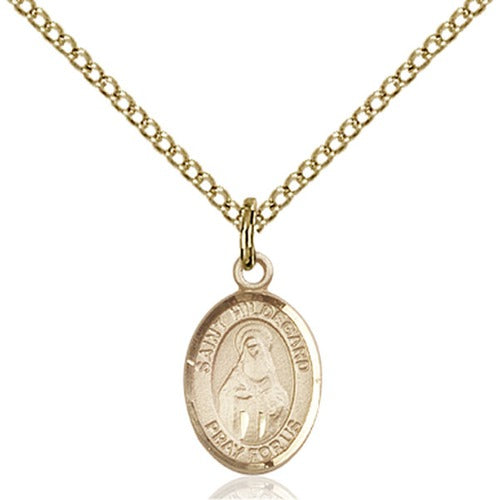
St. Hildegard of Bingen lived almost a thousand years ago. So why is this medieval mystic experiencing such a resurgence of interest today? While I've known of her for years, I've watched with fascination as a new generation discovers this remarkable saint. Young people especially seem drawn to her authentic voice, uncompromising witness, and her integrated vision of faith and the natural world.
Brief Introduction to St. Hildegard Von Bingen
Hildegard was born in 1098 at Bermersheim, Alzey, to noble parents who were wealthy landowners. At eight years old, she was received as an oblate at the Benedictine Abbey of Disibodenberg, where in 1115 she made her religious profession. While she was infirm for much of her life, she committed herself to the renewal of religious life. At the time of
Proclaiming Saint Hildegard of Bingen a Doctor of the Church on Oct. 7, 2012, Pope Benedict XVI spoke about her biography:
"At the basis of her spirituality was the Benedictine Rule which views spiritual balance and ascetical moderation as paths to holiness. Following the increase in vocations to the religious life, due above all to the high esteem in which Hildegard was held, around 1150 she founded a monastery on the hill of Rupertsberg, near Bingen, where she moved with twenty sisters. In 1165, she established another monastery on the opposite bank of the Rhine. She was the Abbess of both.
Within the walls of the cloister, she cared for the spiritual and material well-being of her sisters, fostering in a special way community life, culture and the liturgy. In the outside world she devoted herself actively to strengthening the Christian faith and reinforcing religious practice, opposing the heretical trends of the Cathars, promoting Church reform through her writings and preaching and contributing to the improvement of the discipline and life of clerics."-APOSTOLIC LETTER Proclaiming Saint Hildegard of Bingen, professed nun of the Order of Saint Benedict, a Doctor of the Universal Church, BENEDICTUS PP. XVI
Amazingly, St. Hildegard's legacy reaches across nine centuries, but four aspects of her extraordinary life speak with particular clarity to us today:
1. She Reminds Us to Wonder at Creation.
We live in an age of constant distraction, tied to screens and digital demands. Like no other time in history, we are saturated with images and activity, and it's not hard to see that we have lost touch with how to recognize the fingerprints of the Creator in His creation. When our attention is consumed by what is fleeting, our vision of God’s presence can grow dim. St. Hildegard offers us a powerful antidote to this spiritual blindness: she directs us outward and upward, to God revealed through His creation. She saw the natural world as alive with meaning, filled with what she called viriditas, the “greening power” of God that brings renewal and healing. Her reverence for creation calls us to recover a sense of wonder and gratitude for the world God made.
We might mistakenly view this as a kind of nature worship, but for St. Hildegard, viriditas was the life-giving power of the Holy Spirit made visible in the world. She saw it in the sprouting seed, the healing herb, and the flourishing of the human soul in a state of grace. She wrote:
“O most honored Greening Force, You who roots in the sun; You who lights up, in shining serenity, within a wheel that earthly excellence cannot comprehend. You are enfolded in the weaving of divine mysteries. You redden like the dawn and you burn like the flame of the sun.”-St. Hildegard of Bingen, Liber Divinorum Operum (The Book of Divine Works)
It is not surprising that one of the consequences of living in this digital age is a longing to get back to nature and to appreciate the simple things in life. Perhaps this is one reason for the rise of the Homesteading movement. Yet true simplicity is not a mandate to move to the country, buy chickens, or make our own bread (all good things). True simplicity, as the Church understands it, is about ordering both our exterior life and our interior life toward God. And the Church herself offers a beauty and simplicity that is unmatched.
"The Catholic Church is a home for seasonal living... The liturgical calendar marks time, as does nature... The rhythm of the seasons dictates life - as do the seasons of fasting and feasting. These small shifts in routine - for instance seeing a priest in red vestments - help our focus hone in on the present moment." Theology of Home IV: Arranging the Seasons
St. Hildegard understood this well. While she was deeply attuned to the natural world, she also recognized that the human heart longs for the kind of simplicity that restores us to God, our Creator. This kind of spiritual clarity that sees past the externals to what truly matters is precisely what makes her such a compelling guide for our own time, even though she lived in the 1200s.

Painting By St. Hildegard (Getty Images)
2. She Unites Care for the Body, Mind, and Soul
Modern culture promotes wellness trends, but Hildegard had already integrated medicine, food, and faith into a unified vision. She believed that caring for the body was inseparable from caring for the mind and the soul. In her writings, she described the healing properties of plants, foods, and even music. At a time when we are more aware of stress, anxiety, and the need for balance, her wisdom feels particularly relevant.
“The soul is the greening life force of the body, and the body is the workshop of the soul. -St. Hildegard of Bingen, Liber Divinorum Operum (The Book of Divine Works)
This is a profoundly Catholic vision of the human person. It sees the body as a temple of the Holy Spirit and the created world as a gift to be cherished and understood. I see signs of this desire for wholeness in my own adult children, some of whom are now parents themselves. There is a noticeable shift toward living in a more integrated way. They are choosing organic foods, questioning the medicines we take, seeking out natural fabrics, and cultivating their own gardens. These longings are not new. Nearly a thousand years ago, St. Hildegard was speaking about many of the same things: the healing power of plants, the importance of balance, and the way God reveals Himself through the natural world.
St. Hildegard's music is still performed today. Not long ago, I attended a concert at my church where a woman performed St. Hildegard's works of poetry and music, and it was profound. But it is not just beautiful music; it is music that is designed to lift the mind to God.
This stands as a reminder that beauty is not a luxury but a necessity for the human soul.
3. She Champions The Feminine Genius
-APOSTOLIC LETTER Proclaiming Saint Hildegard of Bingen, professed nun of the Order of Saint Benedict, a Doctor of the Universal Church, BENEDICTUS PP. XVI
4. She Calls for a Church of Authentic Reform
Hildegard reminds us that true reform is not about changing the externals, but about converting the heart. As Pope Benedict XVI noted, she had a deep “understanding of the reform of the Church, not as an empty change of structure but as conversion of heart.”
St. Hildegard lived in a time of corruption and turmoil in the Church, and she was not afraid to speak out against it. She called clergy and laity alike to a life of greater holiness and integrity. She saw that the problems in the Church were not ultimately problems of structure, but problems of sin. And the answer to sin is not a new program, but a conversion of heart.
In one of her visions, St. Hildegard saw the Church as a beautiful woman, but one whose robes were torn and stained by the sins of her children. This vision gave her a profound sense of urgency to call for repentance and renewal:
“The Bride of my Son is as if a widow. The apostles have established her, and she has been endowed with the blood of my Son. But her leaders are negligent… They have sullied her face with dust and have torn her tunic.”
This is not the language of a mild theologian, but of a woman who loved the Church enough to speak the hard truth. She knew that the Church is not a human institution, but the Bride of Christ, and that her holiness is a matter of eternal consequence.
In our own time, Hildegard’s call to authentic reform is still relevant. She reminds us that the renewal of the Church begins not in committees or synods, but in our own hearts. It begins when we turn away from sin and turn back to God. It begins when we, like Hildegard, fall in love with the beauty of the Church and are willing to suffer for her purification.
"Hildegard also saw contradictions in the lives of individual members of the faithful and reported the most deplorable situations. She emphasized in particular that individualism in doctrine and in practice on the part of both lay people and ordained ministers is an expression of pride and constitutes the main obstacle to the Church’s evangelizing mission to non-Christians". -Proclaiming Saint Hildegard of Bingen, professed nun of the Order of Saint Benedict, a Doctor of the Universal Church, BENEDICTUS PP. XVI
Her Example of Humility
As a Benedictine oblate myself, I find myself returning again and again to St. Hildegard's example. Benedictine spirituality has shown me that humility is not weakness but strength. It is the strength that comes from knowing who we are in the eyes of God. Before encountering the Rule of St. Benedict, I mistakenly thought humility was passive; a quiet acceptance or gentle temperament. But St. Benedict teaches that true humility is intensely active work. It demands the constant effort of dying to self, of choosing God's glory over our own recognition, of speaking truth even when it costs us. St. Hildegard embodied this kind of humility, never claiming her insights as her own, yet not hesitating to speak when God called her to do so. In a world that confuses humility with silence and confidence with pride, she shows us a different way.
It's wonderful to see young people drawn to St. Hildegard!

St. Hildegard's Garden: Recipes and Remedies For Healing Body And Soul
St. Hildegard, pray for us!