" It is studying those closest to Christ that we come to understand Him and to follow Him better. This Bride of the Crucified leads us to Him who was crucified for love of us. The more we understand her, the more we can understand Him."
—Fr. Christopher Rengers O.F.M.Cap., The 35 Doctors of the Church
The Church celebrates the feast of St. Catherine of Siena on April 29.
Although this Doctor of the Church died when she was only thirty-three years old, she accomplished much in her short life. She is known as a key advisor to Pope Gregory VI and the reason that the papacy returned to Rome from Avignon, France.
As much as St. Catherine achieved in her lifetime, however, it is her message (which lives on to this day through her many writings) that seems to have had the most influence.
We can make the mistake of thinking that, because she lived during the Middle Ages, her message is for a different time. Yet there is much to learn from St. Catherine even today.
To quote another saint who lived almost a thousand years before St. Catherine, her message is "ever ancient, ever new" (St. Augustine). Catherine spoke about basic truths of Christianity, but she revealed them in frank and straightforward ways which made others take notice and desire to grow in knowledge of God.
The Cell of Self-Knowledge
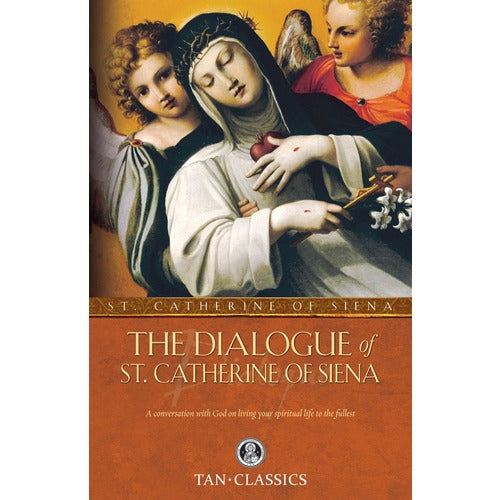
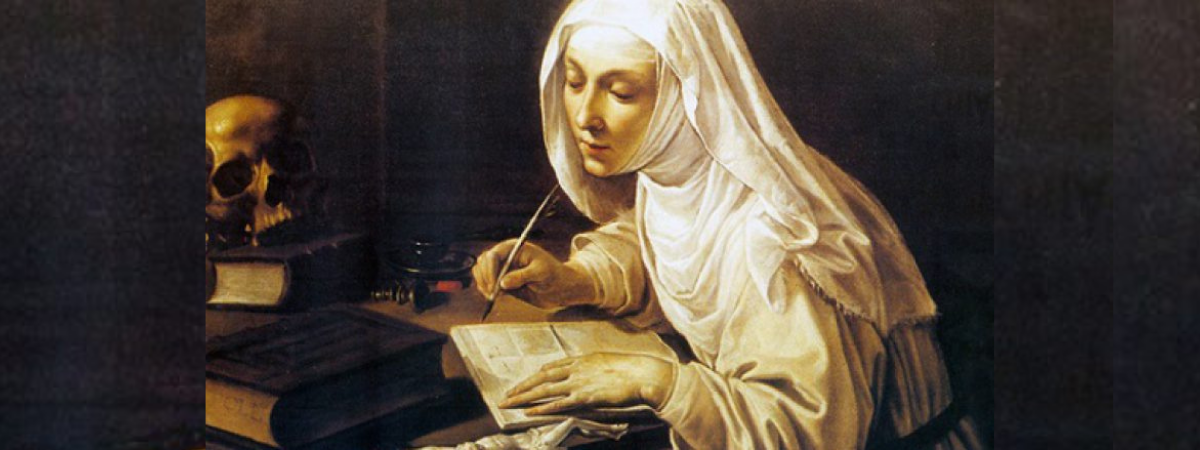
St. Catherine understood that we must know ourselves in order to know Our Lord. She emphasized that, as creatures, we should live in "the cell of self-knowledge" so that we can recognize our proper place in relation to our Creator. The Dialogue of St. Catherine of Siena is a renowned spiritual guide detailing the interior life through conversations between God and the soul, as experienced by St. Catherine herself.
A story from her spiritual director (who wrote one of her biographies) helps to illustrate this. He revealed that she once pleaded with God because she wanted every soul to be saved. Frustrated because she could not understand how any soul should be lost, St. Catherine's spirit wrestled with God "as had Jacob and Abraham," and although she knew it had to be because those souls followed their own perverse wills, she could not understand why her prayers and her offerings couldn't prevent this.
She cried out to God, but He did not answer. Finally she asked Him:
"Tell me Lord, who am I, what am I? Lord, tell me also, who and what art Thou?" The answer that came back burned in her memory forever the distance between the Creator and the creature. "Daughter, thou art she who is not. I am He who is."
—Fr. Christopher Rengers O.F.M.Cap., The 35 Doctors of the Church
St. Catherine's writings fall under three categories: her letters, her prayers, and The Dialogue.
She could barely write (only a few of her letters were written by her hand—and those were considered 'miracles') but many of her writings are known to have been dictated during or after her many ecstasies.
The Dialogue is a beautiful conversation between St. Catherine and God. While it might take a little time to get used to reading the style of this "dialogue" anyone who does will quickly discover the affectionate relationship between this saint and her Lord. He offers her guidance and direction using analogies to emphasize how to grow in virtue and love for Him.
[[st-catherine-of-siena-world-on-fire-print, 1197,personalized-female-heroes-saint-box]]
At one point, God tells St. Catherine how He has sent His Son, Jesus Christ, to be the Bridge we must cross to obtain our salvation:
"I have given you the Bridge of My Son, in order that, passing across the flood, you may not be drowned, which flood is the tempestuous sea of this dark life. See, therefore, under what obligations the creature is to Me, and how ignorant he is, not to take the remedy which I have offered, but to be willing to drown."
It could be said that St. Catherine of Siena made it her life's mission to help fellow Christians to take the remedy which God has given.
Her story is that of a soul responding with heroic and complete generosity to God's very special graces.
—Fr. Christopher Rengers, O.F.M. Cap.
The Life of St. Catherine of Siena
Catherine was the twenty-fourth of twenty-five children born to the Benincasa family, and one of only twelve who survived childhood.
"Little Catherine" was known to be a pious and joyful child, often playing "hermit" at home and finding corners in her home to pray and think.
"It is true to say that St. Catherine as a child was like other children; it is also true that she was different," said one of her biographers.
When she was only six years old and on her way home with her brother from visiting her older sister, St. Catherine had a vision of Jesus. He smiled at her and blessed her in the usual manner of a priest. Stephen, her brother, had run ahead, and when Catherine did not follow, he ran back to her, poking at her arm to get her to snap out of her trance and move on. When he did so, Catherine finally turned toward her brother and away from the vision of Jesus, and when she looked back her Savior was gone, causing her to weep and cry out to her brother, "If you had seen what I saw you would not have disturbed me!"
This vision had a profound effect on St. Catherine and afterward, when she was only seven years old, she promised herself to Christ, through Mary, and gave herself over to a life of chastity.
"She understood at least that this meant to complete giving of herself to the one she loved, to Jesus who had smiled upon her and had blessed her."
—Fr. Christopher Rengers O.F.M.Cap., The 35 Doctors of the Church
For much of her young life, Catherine lived in a quiet hidden way, away from the noises of even her family life. Yet as she grew into her teen years, her mother and sister pleaded with her to live a more worldly life, and so for a few years she indulged, wearing nice clothes and makeup, dying her hair, and going to city events.
But when that very sister who had persuaded her to live more in the world died in August 1362, she wept over her own "apostasy." Refusing the marriage that her family had planned for her, she cut off her hair and demanded that she be treated as a servant in her own home. Her parents, Giacomo and Lapa acted out of love to try to get her to do what they thought was best for her. One day they saw a dove hover above her daughter Catherine's head as she prayed, and seeing this as a sign, they told the rest of the family to leave Catherine in peace.
During her time as “a hermit” at home, St. Catherine only went out to church and while there kept habitual silence. She lived this way for almost three years, after which time she heard God calling her to lead a more active life.
He spoke to her saying, “Dost thou not remember that though wouldst clothe thyself in a man’s garments and become a friar preacher in strange lands?” She asked God how this should be since “I am but a woman and I am ignorant. What can I do?”
To which she heard Him reply:
“In my sight there is not man nor woman, not learned nor unlearned. But know that in these last times the pride of the so-called learned and wise has risen to such heights that I have resolved to humble them. I will therefore send unlearned men full of divine wisdom, and women who will put to shame the learning that men think they have.”
St. Catherine joined the Mantellate, a group of Dominican women tertiaries, and became the first unmarried woman to wear the black and white Dominican habit.
Like many other saints, Catherine experienced great torments and temptations from evil spirits, which would continue throughout her entire life. During one such torment, St. Catherine became quite distressed when she felt an evil presence tempting her, saying such things as, Why don't you sleep like other people? Why don't you eat or drink ... and live like other women; have a good husband and children like other women in both the Old and New Covenant such as Rebecca and Rachel...?
Then she seemed to see all kinds of sensuous images which blotted out the crucifix in the room where she was, and danced before her, taunting her. She cried out, "Even if my Creator would condemn me in the end, I will not for one instant cease from serving Him...I trust in Our Lord Jesus Christ."
[[set-the-world-on-fire-a-4-week-personal-retreat-with-the-female-doctors-of-the-church,the-dialogue-of-st-catherine-of-siena]]
She repeated the name of Jesus over and over again, until the room cleared out of the demons and she smelled a fresh and beautiful fragrance. A light broke out and she saw Jesus on the cross bleeding from his wounds. "Where were you, O good and sweet Jesus, when my soul was being so sorely tormented?" she asked Jesus.
Our Lord replied by telling her that He was in her heart and that He would never abandon her: "I will not leave anyone who does not first leave Me."
Jesus asked her how she felt in the midst of the unclean spirits, to which she replied, "Oh, I hated them. I was in despair over them." Jesus explained to St. Catherine, "And why do you think you felt thus but because I was present in your soul and kept all its gates closed so that those evil visions could not enter?"
![]() Followers of St. Catherine
Followers of St. Catherine
As St. Catherine became more and more known around Siena, she began to have followers. She also began to have more mystical experiences. She could "smell the sin" when a sinner was near to her and it would sometimes be revolting and nauseating.
She lived long periods of time with no nourishment other than the Most Holy Eucharist. She received the Stigmata (the wounds of Christ). She would often go into periods of ecstacy. Her biographer explained that "she could tell her spiritual family (her followers) exactly what each one had been doing, especially if anyone had lost or won a notable spiritual battle. Once, when her brother was in a distant place committing a serious sin, she became aware of a strong stench. She met him upon his return and urged him to quick repentance."
St. Catherine of Siena also attracted enemies who, because of the ecstasies she would often experience during Mass, felt that she was "showing off" and causing scenes. Even her own mother became distressed at her daughter for causing disruptions during Mass.
Yet St. Catherine developed a group of “disciples” who became known as Caterinati (Catherine's children), and eventually her mother and sister-in-law were among them.
It is interesting to note that today in Siena, Italy, there is a group of lay people who are devoted to St. Catherine who are called Caterinati. They prepare the city each year for nine days prior to the feast of their beloved saint.
St. Catherine the Peacemaker
During her own time, St. Catherine was known as a peacemaker, and called by many in the city of Siena (and beyond) to help dispel quarrels and to settle arguments. She was invited to meet with various leaders and was sent on embassies to promote peace.
Her most well-known success in this regard was convincing Pope Gregory XI to go back to Rome from Avignon, France, where he was living due to threats against the Church and his life in particular. On October 4, 1970, during his declaration of St. Catherine as a Doctor of the Church, Pope Paul VI called this the “masterpiece of her work” which will be remembered as her “greatest glory and will constitute a quite special claim to everlasting thankfulness on the part of the Church.”
[[36409, life-of-st-catherine-of-siena,st-catherine-of-siena-framed-print]]
The reasons for the Pope being in Avignon were many. The French Cardinals and papal court were entrenched at Avignon, France, having been in residence there since 1309. The Pope was French and at the time Italy was divided into warring sections, creating an unsafe environment for the Pope. There were threats against his life and even hints of his assassination if he returned to Rome from Avignon. His own father told Pope Gregory that he would have to "step over his own father's body" to go back to Rome—that was how much he feared for his son’s life.
In the end, Pope Gregory did indeed step over his father, who lay himself down across the doorstep, when he finally left Avignon—all at the persistence and persuasion of St. Catherine—to return to Rome in January 1377.
One of the greatest means that St. Catherine used to convince the Pope to leave France for Italy was to whisper in his ear a secret known only to himself and God—something the Pope had promised to God long ago—that he would return one day to Rome.
Sadly, shortly after the Pope returned to Rome, he died. The new Pope, Urban VI, immediately began to push for reforms in the Church and many accused him of pushing too harshly.
The French Cardinals, who had been influential in electing him, began to doubt the validity of his papacy and they elected a new pope: Robert of Geneva, who took the name of Clement VII, but who was an anti-pope. Thus began the Great Western Schism that would last for forty years.
During that time, St. Catherine never acknowledged this new pope. She pleaded for Catholics to stay loyal to the true pope, Pope Urban VI, calling him “sweet Christ on earth.” She offered up her own sufferings and even her life for the Pope.
In Rome, she lay on her bed in corpse-like fashion, truly too sick to get up, being attacked by evil spirits who wanted division to reign in the life of the Church. “Her prayers were of such intensity that one hour of prayer consumed that poor little body more than two days upon the rack would have done for another,” wrote Barduccio Carrigiani.
Fr. Bartolomeo offered Mass in her room on Easter Sunday and after this she seemed to undergo a final struggle. She cried out many times, “O Lord have mercy on me! Take not away from me the memory of Thee.”
Finally, she “confessed her faults before all present, and asked for sacramental absolution again and the plenary indulgence…True to her life-long loyalty, she again prayed for the Church and the Pope and proclaimed Urban VI as the true Vicar of Jesus Christ.”
The final words of St. Catherine of Siena were the same as her Lord’s: “Father, into Your hands I commend my spirit.”
It was around the hour of noon on April 29, 1380.
[[set-aside-every-fear-30-days-with-st-catherine-of-siena,the-dialogue-of-st-catherine-of-siena]]
Her Writings Live On Today
It might be easy to assume that St. Catherine, who displayed a holiness from an early age, is hard to relate to. After all, she had a vision of Our Lord when she was six years old, and stayed close to Him her entire earthly life.
Yet to assume this would be to assume that Our Lord does not communicate through others and that we can never learn from those we wish to emulate. In fact, it is this sweet and holy child of God to whom we should listen when we are seeking an example in the life of holiness.
Her biographer said of St. Catherine: "She is among the few guides of humanity who have the perfect manner, the irresistible attractiveness, of that positive purity of heart, which not only sees God, but diffuses Him, as by some natural law of refraction, over the hearts of men."
Although she lived so long ago, St. Catherine of Siena speaks to us down through the centuries and even to this day. She tells us that God loves us unconditionally, and yet we cannot love Him as He deserves because of our "creatureliness."
While we could never make up for the sins of mankind against God, He gave us His Son as the Bridge to save us. St. Catherine carries to us the very simple message that it is through one another that we show our love for God. It is through our neighbor that we can love God, plain and simple.
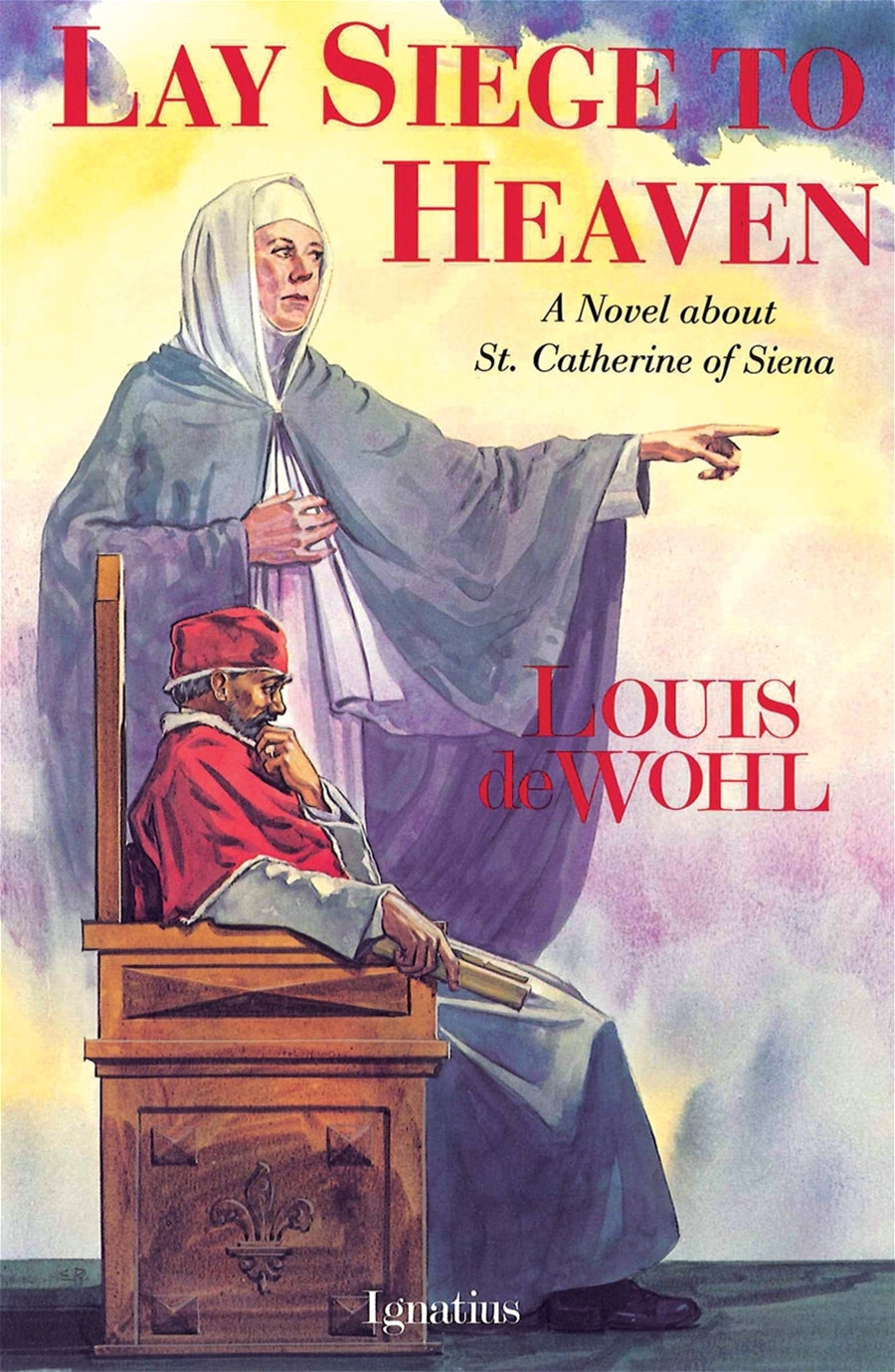
You can purchase The Dialogue of St. Catherine of Siena here.