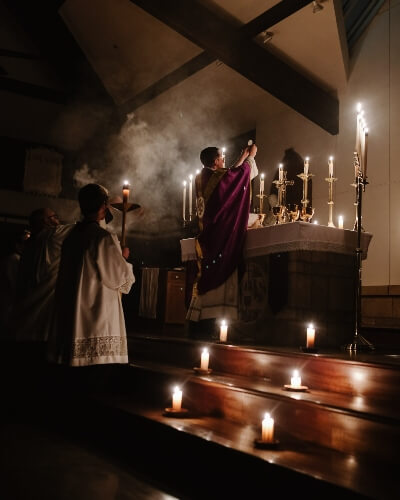


If you’ve ever wondered why the Catholic Mass sometimes feels so majestic, symbolic, and almost otherworldly, you’re not alone. Many Catholics sense that something extraordinary is happening in the liturgy — something that transcends time and space.
What many do not realize is that the Mass as we know it is not only shaped by the Last Supper and Christ’s command to “do this in memory of me.” In a profound way, it is modeled after the heavenly worship described in the Book of Revelation.
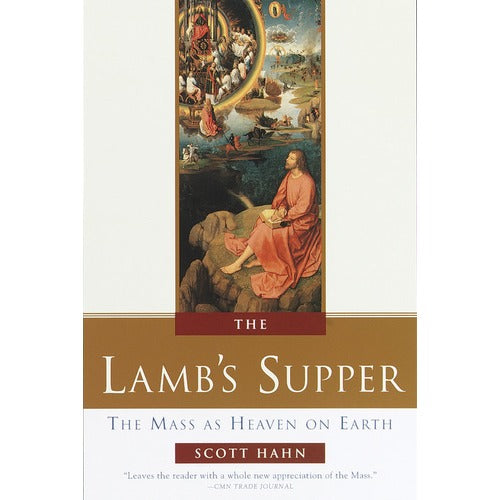
The idea may sound unfamiliar, but it’s deeply rooted in Scripture and early Christian imagination — and one of the clearest theological explorations of this is found in The Lamb’s Supper: The Mass as Heaven on Earth by Professor Scott Hahn.

A Heavenly Feast Foretold
In Revelation 5 and 7, John’s vision draws us into the throne room of God:
“Then I saw a Lamb, looking as though it had been slain, standing at the center of the throne… and they sang a new song…”
(Revelation 5:6, 9)
Later he sees a great multitude crying out:
“Salvation belongs to our God who sits on the throne, and to the Lamb!”
(Revelation 7:10)
What makes Hahn’s book so captivating is his observation that the structure of the Mass reflects this vision of heaven.
In Revelation, worship begins with adoration before the throne. The Mass begins with the Introductory Rites and the Kyrie. In heaven, the Lamb is presented, slain yet victorious. In the Mass, we present the Lamb in the Eucharist — crucified, risen, and present.
Then the heavenly assembly proclaims praise, thanks, and glory. In the Mass we hear the Gloria (outside of penitential seasons), the Sanctus, and the Eucharistic Prayer — all lifted in praise and thanksgiving.
One striking detail Hahn highlights is the connection between the Table of the Lord and the table before the throne in Revelation.
In Revelation 19:9, the heavenly angels say:
“Blessed are those who are invited to the wedding feast of the Lamb.”
This “wedding feast” language is not incidental. In the ancient world, a banquet was a symbol of covenant friendship. God’s ultimate covenant in Christ is sealed not with a handshake, but with a feast — the Eucharist.
Hahn points out that the structure of the Mass — the Liturgy of the Word followed by the Liturgy of the Eucharist, the prayers of offering, the breaking of the bread, and the sending forth — mirrors the pattern of divine worship described in Revelation.
In other words, when we gather for Mass, we are not just remembering Christ’s Last Supper. We are entering a foretaste of the heavenly liturgy — the marriage feast of the Lamb.
In The Lamb’s Supper, Professor Hahn recounts a moment from his own experience as a convert and Scripture scholar. Early in his Catholic journey, he was struck by how often Revelation wasn’t quoted in Protestant worship but was central to the Catholic imagination of liturgy. It wasn’t a random academic curiosity — it was a lived reality in the prayers, gestures, and signs of the Mass itself.
He noticed that several elements of the Mass — the procession, the prayers of praise, the offering, the “amen” chorus — had uncanny parallels in the heavenly scenes of Revelation. It was a pivotal insight, not only for his scholarship, but for his experience of the Mass as participatory, cosmic worship.
Why This Matters for Us
Understanding that the Mass is patterned on Revelation does more than satisfy theological curiosity. It transforms our participation.
The Second Vatican Council teaches that the liturgy is “the summit toward which the activity of the Church is directed” and “the font from which all her power flows” (Sacrosanctum Concilium, 10). When we see the Mass as heaven on earth, it becomes clear that we are not in a classroom, not in a meeting, not even simply in a meal. We are entering into the same worship the saints and angels offer around the throne of God.
The Catechism echoes this mystery:
“In the liturgy we are given a share in what is ‘going on’ in heaven: Christ is there in person… and the worship of the Church is united with that of the whole heavenly liturgy.” (CCC 1136)
In every Eucharistic celebration, heaven and earth meet. The veil between this world and the next is thin. The Lamb who was slain stands with us, and we with Him.
A Book to Deepen Your Worship
If this sounds like something you want to explore more — not just intellectually, but spiritually — The Lamb’s Supper: The Mass as Heaven on Earth offers a beautiful and profound guide. Professor Scott Hahn unpacks Scripture, history, and theological insight in a way that helps Catholics see the Mass with fresh eyes and renewed awe.
Discover yours today at The Catholic Company!