It’s one of those details in the Gospels that is easy to pass over. After the Crucifixion, we are told that Jesus’ body was not simply placed in the tomb, but prepared with care, reverence, and costly burial ointments.
St. John records: “Nicodemus… came bringing a mixture of myrrh and aloes, about a hundred pounds’ weight. They took the body of Jesus and bound it in linen cloths with the spices, as is the burial custom of the Jews” (John 19:39–40).
That detail—about a hundred pounds—should give us pause. This was not a minimal or hurried burial. It was lavish. Myrrh and aloes were precious substances, fragrant resins used in burial to honor the dead and to help preserve the body. The quantity used here far exceeds what would have been typical, suggesting something more like the burial of a king than that of a condemned criminal.
Myrrh, in particular, appears at key moments in Christ’s life. It was one of the gifts brought by the Magi at His birth, traditionally understood as a foreshadowing of suffering and death. Now it appears again at the end of His earthly life, completing a kind of quiet arc that runs from Bethlehem to Calvary. From the beginning, there were signs that this life would be given completely.

There is also something striking about who performs this act. Joseph of Arimathea and Nicodemus step forward at a moment when many others had fled. Their actions are not dramatic, but they are deeply faithful. They offer what they can—time, courage, and costly devotion—at a moment when it might have seemed that everything was lost.
The Catechism reminds us that Christ truly entered into death: “By the grace of God Jesus tasted death for every one” (CCC 624). His body was handled, anointed, wrapped, and placed in the tomb according to human custom. Nothing about His death was symbolic or incomplete. It was real.
And yet, there is a quiet tension in this moment. These spices were prepared for a body that would remain in the grave. They were part of the final acts of love offered to someone believed to be gone. But on Easter morning, when the women came to the tomb bringing additional spices to complete the burial preparations, they found something entirely unexpected.
The stone had been rolled away.
The ointments had been carefully prepared, but they were not needed for long.
All the reverence, the care, the expense—everything that seemed to belong to an ending—becomes part of a greater story. The burial itself becomes a witness, not only to the reality of Christ’s death, but to the truth that death did not have the final word.
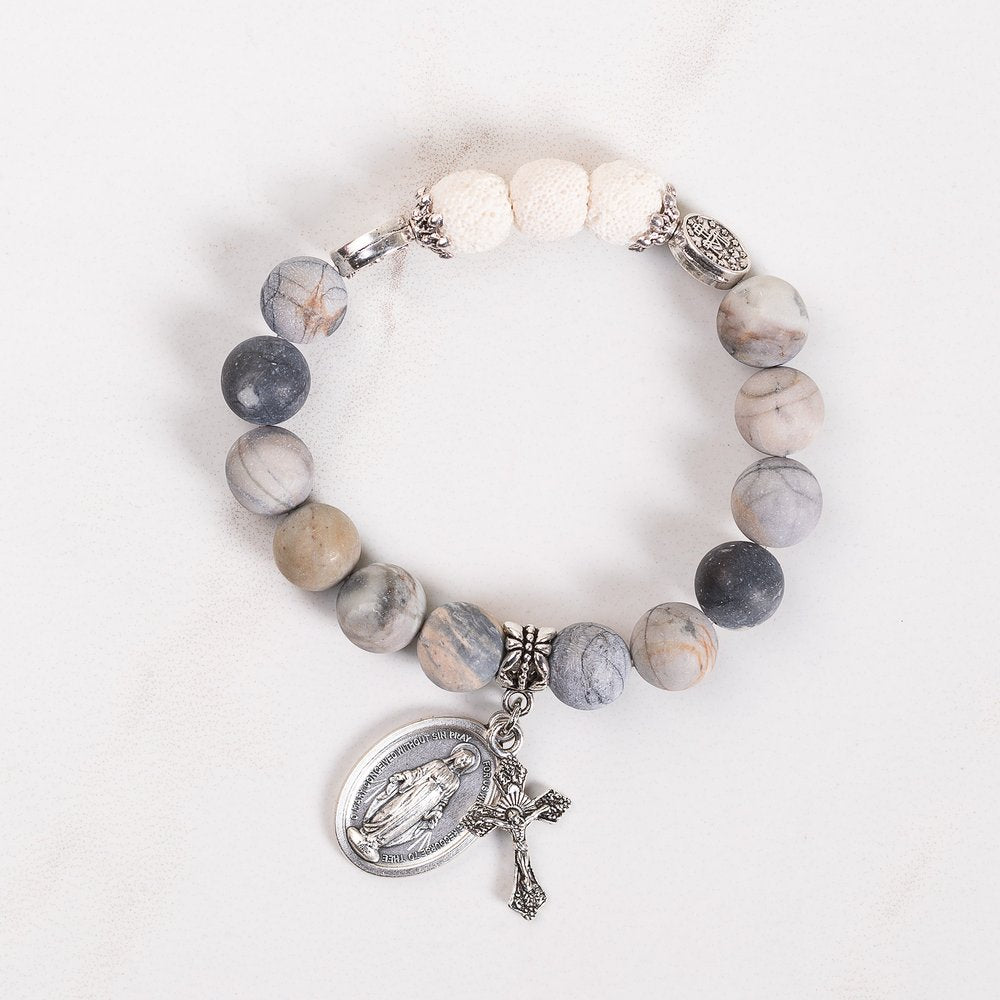
Discover the beautiful Miraculous Medal Essential Oil Bracelet.
Three ivory lava beads on the bracelet allow you to apply essential oils for a delightful aroma experience. Find yours today at The Catholic Company!