All Saints Day and All Souls Day fall back-to-back on the Church calendar, but their connection goes far deeper than their dates. Together, they reveal something extraordinary about what Catholics believe happens beyond death—and about the bonds that still unite the faithful on earth, the souls in Purgatory, and the saints in heaven.
Understanding these two days helps us understand the Communion of Saints itself: why we ask the saints to pray for us, why we pray for the dead, and why death does not sever our life together in Christ.
What is the Difference in All Saints and All Souls Day?
The placement of the two ancient feast days of All Saints and All Souls is no coincidence. On November 1, All Saints Day, the Church lifts our eyes to heaven to celebrate those who have reached the goal of the Christian life and rejoice forever in God's presence.
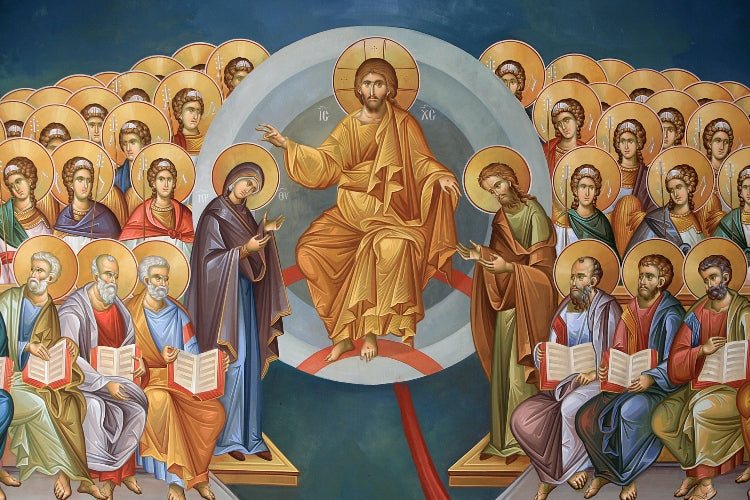
They are called the Church Triumphant, because having received their heavenly inheritance, they live forever with the Lord in glory. Their lives remind us that holiness is possible and that every Christian is called to become a saint. The saints whose images, medals, writings, and devotions fill our Catholic tradition continue to point us toward that same heavenly destination. Wearing saint medals as reminders of heavenly intercession can help us keep that communion close in daily life.
The very next day, All Souls Day, the Church turns our attention to the Holy Souls, the faithful departed who are still being purified before entering heaven.
They are traditionally known as the Church Suffering, because of their temporary separation from God and their longing to be in union with Him. Assured of eternal life after purification in Purgatory, they will join the Church Triumphant when purified.
Together, the feasts of All Saints and All Souls tell the story of every Christian. The saints inspire us by reaching our final destination in heaven. The Holy Souls remind us that our journey toward perfect holiness may continue after death, until every effect of sin has been healed and purified.
And then there is the Church Militant - those of us still completing our earthly lives, striving against sin and growing in holiness by the grace of God.
These three names do not describe three different Churches, but three states of being in the one Church. The saints in heaven and the Holy Souls intercede for us. We pray for all the faithful departed. We remain spiritually united as members of the one Body of Christ.
The History of All Saints Day and All Souls Day
Long before these feast days appeared on the Church calendar, Christians were already honoring the saints and praying for the dead.
In the earliest centuries, believers gathered at the tombs of the martyrs to celebrate the Eucharist on the anniversaries of their deaths—the days they entered eternal life. As the number of saints grew, the Church eventually established a single feast honoring all the saints, including the countless holy men and women known only to God.
During the eighth century, Pope Gregory III dedicated an oratory in St. Peter's Basilica to all the saints and established November 1 as a day for their celebration in Rome. Pope Gregory IV later extended the November 1 observance more broadly throughout the Western Church.
At the same time, Christians continued another ancient practice: praying for the faithful departed.
Early inscriptions in the Roman catacombs and other elements of Church history bear witness to prayers for those who had died, and ancient Christian liturgies include petitions for their eternal rest. In 998, St. Odilo of Cluny designated November 2 as a special day of prayer for all the faithful departed. The observance eventually spread throughout the Western Church.
The history of these two feasts reveals something important:
Honoring the saints and praying for the dead were never disconnected practices. Both grew from the Church's conviction that those who die in Christ remain part of His Body forever. All Saints' Day celebrates that communion fulfilled in heaven; All Souls' Day asks us to participate in it through prayer.
But that raises a question Catholics are often asked: Why pray for someone who has already died?
Why Do Catholics Pray for the Dead?
For Catholics, praying for the dead flows naturally from the Communion of Saints. If death does not separate us from Christ's Body, neither does it end our love for one another.
We pray for our family and friends while they are alive because we love them. That love does not suddenly disappear when they die. Instead, we continue to entrust them to God's infinite mercy, drawing upon the prayers and devotions the Church has given us to remember and assist the faithful departed.
This practice is rooted in Sacred Scripture.
In 2 Maccabees 12:44-46, Judas Maccabeus offers prayers and sacrifices for fallen soldiers, so they might be freed from the effects of sin, calling it "a holy and pious thought to pray and make atonement for the dead based on the hope of the resurrection."
St. Paul also describes a final purification in 1 Corinthians 3:13-15, explaining that a believer devoted to God but not yet purified at death "will suffer loss, but he himself will be saved, but only as through fire."
From the earliest centuries, Christians understood this passage as referring to God's final work of purification in those destined for heaven.
The witness of Scripture, together with the uninterrupted practice of the early Church, forms the foundation for the Catholic tradition of praying for the faithful departed. To fully understand why those prayers matter so much after death, we must understand what the Church teaches about Purgatory.
If Their Eternal Destiny Is Already Decided, Why Pray for Them?
The Church teaches that every soul in Purgatory is already saved. Their eternal destiny is not uncertain. They belong to Christ and will one day enter heaven.
We on earth, however, do not know with certainty that a loved one has already reached heaven, so we continue to pray earnestly for the faithful departed and entrust them to God's mercy.
Why do our prayers help them? Because God allows the members of Christ's Body to assist one another through prayer. Just as we pray for those still living, the Church teaches that our prayers, sacrifices, indulgences, and especially the Holy Sacrifice of the Mass can benefit the faithful departed undergoing their final purification.
Our prayers do not persuade God to become merciful. Rather, God in His providence allows our prayers to become instruments of the mercy He already desires to give. In this way, even death cannot prevent Christians from loving and assisting one another through Christ. We are all able to contribute to the salvation of souls, living or dead, as we unite in prayer.
What Is Purgatory?
Perhaps no Catholic teaching is more misunderstood than Purgatory. Purgatory is the final purification of those who die in God's grace and friendship but are not yet perfectly purified. It is not a second chance at salvation, nor does it mean that Christ's sacrifice was insufficient. Every soul in Purgatory has already been redeemed by Christ, and is destined for heaven.
Scripture tells us that "nothing unclean shall enter" the heavenly Jerusalem (Revelation 21:27). Although our sins may be forgiven, their effects and our attachments to sin can remain. Before we can enter the fullness of God's presence, He lovingly completes the work of sanctification begun in us during our earthly lives.
Purgatory, then, is not evidence of God's reluctance to welcome us into heaven. It is a gift of His mercy—the final work of grace by which He prepares the soul for perfect union with Him.
For those who want to understand this often-misunderstood teaching more deeply, Purgatory: Cleansing Fire takes a closer look at what the Church teaches about purification after death and the hope at the heart of this doctrine.
How Does Purgatory Work? An Everyday Example
A priest I admire very much once gave a symbolic explanation of Purgatory that made it so understandable:
Suppose I borrow a beautiful watch that belongs to you. Unfortunately, I drop it, and break it.
I come to you genuinely sorry, explaining what I've done, and asking you to forgive me. Because you don't wish to lose our relationship, you do forgive my carelessness, and our relationship is restored. You aren't holding the offense against me anymore, but your valuable watch is still broken.
Your forgiveness doesn't magically repair the damage my actions caused. Because I am responsible for that damage, love and justice call me to make things right. I take the watch to be repaired, and pay the cost of restoring what I damaged.
Something similar happens with sin. In Confession, God truly forgives our sins and restores our relationship with Him. We don't have to "pay Him back" for His forgiveness, because Christ has already paid the price for our redemption.
Yet His forgiveness does not typically erase all the effects sin has produced in us over time. Our selfishness, pride, unhealthy attachments, and the damage caused by our choices may still need healing and purification.
We begin that work here through prayer, penance, sacrifice, works of mercy, and faithfully accepting the trials of this life. If we die in God's friendship before that purification is complete, Purgatory finishes what God's grace has already begun.
To be clear, Purgatory is not "paying God for forgiveness." The forgiveness has already been given. It is the loving restoration of what sin has damaged, so that the soul can enter heaven completely healed and perfectly holy.
Far from diminishing Christ's saving work, Purgatory is one of its greatest fruits. The souls there, separated from God for a time while being purified, await only the moment when every obstacle to perfect union can be removed. That is why Catholics pray for the Holy Souls - because love does not stop at the grave.
Remembering the Holy Souls in November
All Souls' Day gives Catholics a special opportunity to put this belief into practice. We can have Masses offered for deceased loved ones, visit and pray at their graves, offer the rosary for the Holy Souls, or seek indulgences for the faithful departed according to the conditions established by the Church.
These practices are not simply ways of remembering people we miss. They are acts of Christian charity rooted in our belief that the faithful departed remain members of Christ's Body and can benefit from the prayers of the Church. For those comforting a grieving friend or family member, Catholic memorial and bereavement gifts can offer a tangible reminder of prayer and Christian hope.
One of the Seven Spiritual Works of Mercy to which all Christians are called is praying for the dead. November is traditionally dedicated to prayer for the Holy Souls. It is our sacred duty of love to sacrifice and pray for our family members, friends, and the forgotten souls whom no one is remembering in prayer.
All Saints and All Souls: One Church, One Hope
Seen together, All Saints Day and All Souls Day reveal something much larger than two observances on the Catholic calendar. They give us a glimpse of the whole Church.
On earth, the Church Militant continues the journey toward holiness. In Purgatory, the Church Suffering is being prepared for perfect union with God. In heaven, the Church Triumphant has reached the destination for which every human soul was created.
In a beautiful way, we remain connected, beyond the bonds of life. The saints intercede for us all as we make our way to communion with them in heaven. We pray for the Holy Souls who need prayer as they await the fullness of heavenly glory. Though they cannot pray for themselves, they can offer their prayers for us. Someday, by the grace of God, we will all be united in our heavenly home.
This is the deeper meaning behind November 1 and November 2. All Saints Day reminds us where we are going. All Souls Day reminds us that we can still help one another get there.
Together, they proclaim one of the great consolations of our Catholic faith: in Christ, our bond is as eternal as our immortal souls. In life and in death His Church remains one, God's mercy reaches beyond the grave as He draws His children into perfect communion.
Frequently Asked Questions About All Saints Day and All Souls Day
What is the difference between All Saints Day and All Souls Day?
All Saints Day, November 1, honors all the saints in heaven. All Souls Day, November 2, is dedicated to praying for the faithful departed, especially the souls in Purgatory.
Is All Saints Day a Holy Day of Obligation?
In the United States, All Saints Day is ordinarily a Holy Day of Obligation, although the obligation may be affected by the day of the week on which November 1 falls. Check your diocesan calendar for those details as determined by your Bishop.
Is All Souls Day a Holy Day of Obligation?
No. All Souls Day is not a Holy Day of Obligation in the United States, though Catholics are encouraged to attend Mass and pray for the faithful departed. Many parishes hold memorial masses to celebrate loved ones who have passed into eternity.
Why do Catholics pray for the dead?
Catholics believe those who die in Christ remain united with His Body. Our prayers, sacrifices, indulgences, and especially the Holy Sacrifice of the Mass assist the faithful departed undergoing purification in Purgatory and are important for the Holy Souls.
What is the Communion of Saints?
The Communion of Saints unites the whole Church in Christ: the Church Militant on earth, the Church Suffering in Purgatory, and the Church Triumphant in heaven. Death does not sever this spiritual communion.
Read Next: How Does Someone Become a Saint? The Catholic Canonization Process Explained
Read Next: Purgatory: Why We Believe & What We Can Do

The Saints Pray For You: How the Christians in Heaven Help Us Here on Earth