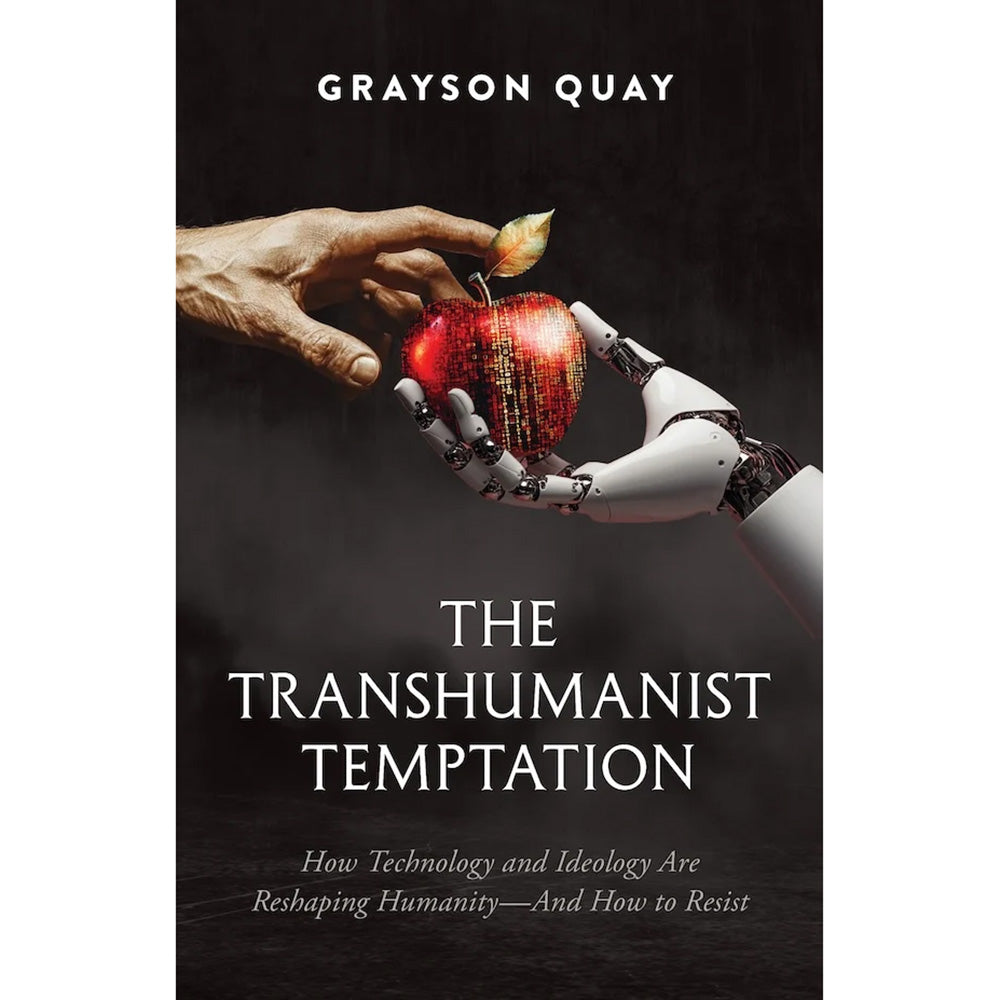
You may have wondered recently, reading an email or article: Did AI write this?
It is a strange new question. One that would have sounded like science fiction even five years ago. And yet here we are.
I recall the first time I used AI. My husband told me about it, and I guess I must have appeared a bit skeptical. So he told me to prompt it to write something. Since I was writing a blog post on St. Francis and the first nativity scene, I laughed... and asked it for a poem on St. Francis and the first nativity scene.
The poem created in seconds was remarkable. I was blown away.
That was a few years ago. What it can do now is even more advanced. Not only can artificial intelligence write poetry, it can create complex spreadsheets, analyze detailed data systems, summarize theology, and answer intricate biblical questions... in seconds.
Most of us are familiar with everyday examples of AI that have been around for a while, like virtual assistants (Siri, Alexa), smart devices that respond to voice commands, product recommendations on retail sites, or navigation apps like Google Maps.
It is worth being clear about what artificial intelligence is, because it is not true intelligence in any meaningful sense. It does not think, reason, or understand. What it does (and does remarkably well) is recognize patterns in vast amounts of existing data and produce something that resembles a coherent response. It is, in a sense, a very sophisticated mirror: it reflects what has already been said, organized and presented in a way that can look, at first glance, like original thought. That is not nothing. But it is also not what we mean when we talk about the human mind, let alone the human soul.
And yet, within those limits, it is capable of genuinely impressive things. It can draw on centuries of Church commentary faster than any human scholar. It can sound compassionate, intelligent, even spiritual.
What Should Catholics Think About AI?
My husband and I recently attended the Legatus Summit in Santa Barbara, California, a conference for Catholic business leaders. One of the speakers was former Google senior vice president and Catholic convert, Vic Gundotra, who candidly shared how he uses AI in his own spiritual life. Raised as a Jehovah’s Witness, Gundotra later became an atheist before eventually discovering the Catholic faith through deep study of Scripture and the early Church Fathers.
He shared that he spends time each morning with the Mass readings, and every day asks AI a simple question: “What do most people miss about this passage?” He has prompted his AI to only give him answers that adhere to sound Catholic teaching found in the Catechism of the Catholic Church or in Scripture.
He described being consistently amazed by the depth of insight AI can surface. "The reason AI can do that is that AI has read all the early Church fathers. AI has read everything the Church has ever written for 2,000 years,” Gundotra said. “...AI can look at any commentary ever written by the Church on those verses and synthesize it, unique to you."
He actually presented a visual slide deck rendered by AI. It had drawn out layers of meaning from that day's readings that would have taken hours (maybe days) to assemble by hand.
While artificial intelligence does not “understand” in the human sense, it can gather, compare, and synthesize information at a scale no human can match. As Gundotra put it, this innovation is more comparable to the invention of fire or the wheel.
But he also called it: "a double-edged sword".
Tower of Babel Moment?
Some have compared this moment to the Tower of Babel in Genesis 11:4, with humanity building a tower “with its top in the heavens.”
We know that story well: "So the Lord scattered them abroad from there over the face of all the earth, and they left off building the city. Therefore it was called Babel, because there the Lord confused the language of all the earth; and from there the Lord scattered them abroad over the face of all the earth" (Genesis 11:8-9)
Is there perhaps something for us to see today in that Biblical image? Not because innovation is evil, but because the desire to be god-like often seems to accompany human progress?
The Catechism reminds us: “The first commandment forbids honoring gods other than the one Lord who has revealed himself to his people” (CCC 2110).
That may sound dramatic in the context of AI. But Gundotra warned that we are at the beginning of a cultural moment where some will treat artificial intelligence as something approaching omniscience. It answers instantly and speaks confidently.
There are aspects of AI that should be obvious, but perhaps are not always so. It does not possess wisdom. It cannot love. It cannot suffer. It cannot pray. It does not possess a soul.
It is not made in the image and likeness of God.
Can AI Deepen Faith?
There is something undeniably powerful about asking a question about Scripture and receiving insight drawn from St. Augustine, St. Thomas Aquinas, St. John Chrysostom, and modern biblical scholarship in a single response.
That is the benefit of AI. Used rightly, it can point us toward deeper study. It can help us ask better questions. As Gundrota showed, it can uncover connections we might otherwise miss.
The benefits of AI are real, and so are the concerns. Many say the real danger is not that AI will suddenly become self-aware and overthrow humanity. It is more subtle than that. There is something genuinely appealing about a tool that can gather everything ever written and present it neatly in seconds. It would be easy to grow accustomed to that. To prefer the quick analysis over the slower work of contemplation.

And in some ways, we probably already have. It is hard not to wonder whether some of the restlessness and anxiety so many people feel today is connected, at least in part, to a world that moves faster than we were made to process.
I notice in myself a kind of quiet impatience. A preference for clarity that arrives instantly rather than slowly. The world today moves fast, with answers for so much right at our fingertips.
There are ways we can counter this impatience. A few of our young adult children have started taking real steps to limit their phone time, not just screen time in general, but being more deliberate about what they actually use their phones for.
Another small antidote is simply reading a spiritual book. Father Jacques Philippe's Interior Freedom is a good example. It is a brief book that helps us to remember that, regardless of our outward circumstances, God is always with us. It is not about artificial intelligence in any way; it's about learning to recognize God in our inner life, and about the kind of freedom that no technology can give or take away.
None of this is to say that using AI is a danger to one's spiritual life per se. But I do find myself wondering about its more insidious effects; the ones that are harder to name. Is something being lost in the race to embrace AI that, once lost, will be very difficult to recover?
Certainly, I worry about what it means for our children and grandchildren. How will it affect their future careers? No one yet knows.
(As I write this a prominent US company announced reducing its organization by nearly half - from 10,000 to 6,000 - saying that while business is doing well, "something has changed. we're already seeing that the intelligence tools we’re creating and using, paired with smaller and flatter teams, are enabling a new way of working which fundamentally changes what it means to build and run a company. and that's accelerating rapidly."- X)
The Church's Response
Pope Leo XIV has identified artificial intelligence as one of the most critical matters facing humanity and a central issue of his pontificate, signaling that the Church intends to address its moral and social implications.
At a recent conference called, “Artificial Intelligence and Care for Our Common Home", Pope Leo said, “The ability to access vast amounts of data and information should not be confused with the ability to derive meaning and value from it,” the Pope explained, adding that “The latter requires a willingness to confront the mystery and core questions of our existence, even when these realities are often marginalized or ridiculed by the prevailing cultural and economic models.”
I doubt many people are seriously suggesting that we should avoid artificial intelligence; we have always used technological tools. As Catholics, we should ask whether something serves the human person and leads us toward truth, goodness, and ultimately toward God.
So, Did AI Write This?
Did AI write this article? You may be scanning it now for em dashes and lists of three, or other signs we have all learned to recognize. I wrote this article, but I used ChatGPT to ask what Catholics are wondering about artificial intelligence. There was no shortage of questions. But underneath all of them, the same concern kept surfacing: what does this mean for us, and where is it going?
While no one can fully answer those questions, we should not be anxious about them either. As Christians, we have always lived inside a story larger than the moment we are in. And that story has not changed.
We should be grateful for our faith in this regard. St. Paul reminds us in Scripture: "We know that all things work together for good for those who love God, who are called according to his purpose" (Rom. 8:28). These words are not a sentimental consolation. They are rooted in the very nature of who God is. Nothing can thwart the intention of the divine will to achieve the highest good through all things. God's goodness cannot fail.
That is where we place our confidence and our hope. Not in the tools we use, but in the Creator of the Universe, the One who holds all things.
Are you looking for a meaningful study for Lent? Or a way to accept God’s will for your life in all circumstances? Discover our acclaimed Good Catholic series, Thy Will Be Done.