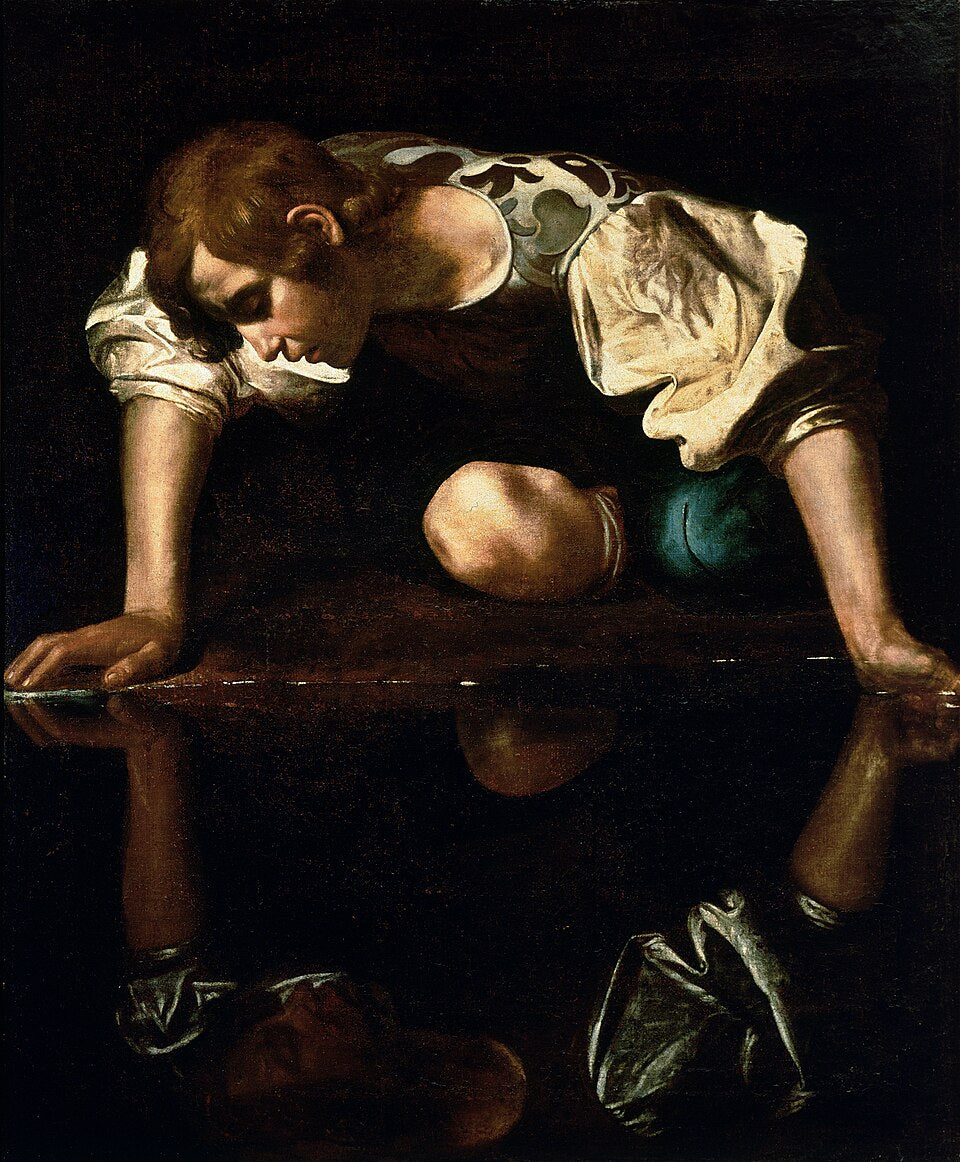
(Painting: "Narcissus" (c. 1597–1599) by the Italian Baroque master Caravaggio)
“I point you to the cell … where you will find knowledge of yourself and his goodness.” St. Catherine of Siena, letter cited in Catherine of Siena Spirituality.
I’ve always considered myself an intuitive person. Over the years, I’ve even taken a certain pride in being “self-aware.” I notice my moods, consider my strengths and weaknesses, and I try to be honest about them. But sometimes that very self-awareness becomes a subtle trap. I’ve caught myself inwardly judging someone as “not very self-aware,” and in that quiet judgment, I realize I’m revealing something about myself. If I feel superior because I notice my flaws while they don’t seem to notice theirs, is that actually self-awareness, or is it just another form of pride? If my ‘self-awareness’ doesn’t lead to humility, repentance, and charity, what is it worth?”
The difference between self-awareness and self-knowledge is important. Self-awareness notices and names things within me; things like patterns, emotions, or tendencies. But it can also remain shallow, or worse, feed my pride. Self-knowledge, on the other hand, goes much deeper. It places me before the truth of who God is, and in that light, reveals who I really am.
In a vision, Jesus asked St. Catherine of Siena, ( The Dialogue of St. Catherine of Siena):
Do you know, daughter, who you are, and who I am? If you know these two things, you will be blessed. You are she who is not; whereas I am He who is. -The Dialogue of St. Catherine of Siena (as recorded by Bl. Raymond of Capua in his Life of St. Catherine of Siena often cross-referenced as Dialogue 2).
We might be tempted to be shocked or somehow offended by this dialogue between Our Lord and St. Catherine. When I first read this, I admit I was taken aback.
But why is that? Could it be our pride is offended? If so, perhaps the discomfort is itself a sign that God is inviting us into a deeper honesty, the kind that can only happen when we stand in His presence.
The more united we are with Our Lord, the closer we come to seeing ourselves as we truly are. This is one of the reasons why prayer is so essential for true self-knowledge. And it is the reason that one obstacle to seeing ourselves as we are might be that we have become complacent in our prayer.
Even if we think we pray a lot, we may still fail to give God our best time or effort. When we do come before God in regular prayer and quiet our minds long enough to attempt to hear His voice, we are recognizing our need for Him. This is the heart of self-knowledge; not simply cataloging my weaknesses, but coming to see myself as utterly dependent on the One who gives me life.
The cell of self-knowledge
St. Catherine of Siena, whose feast day we celebrate on April 29, is a striking example of what it looks like to seek this kind of self-knowledge. She is especially known for urging souls to enter what she called the “cell of self-knowledge,” where we learn to see ourselves in the light of God’s truth and love, not merely as we feel ourselves to be, but as God sees us.
The cell is an invitation to all, not just monks or religious who might experience a true cell in their vocations. While her earliest encounters with God took place in a real, physical room (the solitude of her bedroom in her parents’ home), she also used the cell as a metaphor: an interior refuge where, in God’s presence, we honestly examine our hearts and allow His love and truth to form who we are.
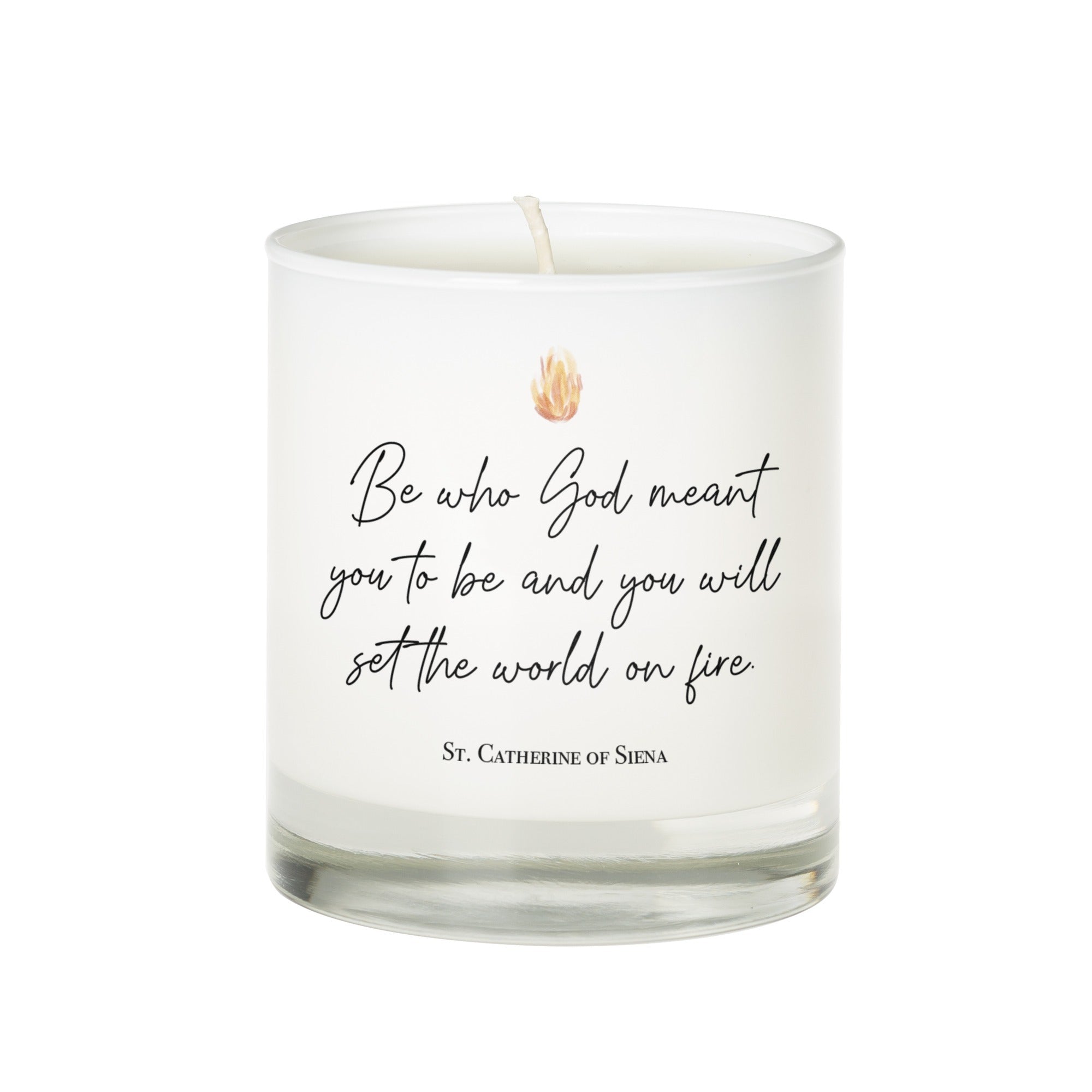
[[st-catherine-of-siena-world-on-fire-candle,the-dialogue-of-st-catherine-of-siena]]
For St. Catherine, the spiritual journey is a slow growth in knowing God’s goodness and seeing ourselves truthfully before Him. Time in the cell was necessary for this dynamic to take place. Thus, becoming accustomed to regularly taking time for such inner experience is a basic first step (and an ongoing one) in the spiritual journey.
This is highlighted in the first paragraph of The Dialogue:
"She [the soul][1] has for some time exercised herself in virtue and has become accustomed to dwelling in the cell of self-knowledge in order to know better God’s goodness toward her, since upon knowledge follows love. And loving, she seeks to pursue truth and clothe herself in it. "(Dialogue 1.25)[2]
I am grateful to St. Catherine for giving us this image. There is something tangible that comes to mind when I consider myself in a "cell" where I can be honest and exposed. In that cell, we come face to face with our nothingness (which, St. Catherine voices, is not worthlessness), and our dependence upon God and His greatness. If we are truly pursuing self-knowledge in this way, we will see our sinfulness, but we will also recognize the goodness and mercy of God.
God's will always works for our good
God always wills the best for us. Even when we don’t understand it in the moment, even when we are in the midst of darkness, even when we aren’t even asking Him, God’s will always works for our good.
St. Catherine of Siena and other saints remind us that just as all things have their origin in God’s eternal goodness, so also all things will find their fulfillment in His goodness. Nothing, no sin, no evil, can thwart the intention of the divine will to achieve the highest and greatest good through all things. And because of that, we can be confident that we ourselves cannot will a higher good for our lives than what He already wills for us, more perfectly than we can imagine.
“God certainly desires our greatest good more than we ourselves desire it. He knows better than we by what way it can come to us; and the choice of ways is wholly in His hands, as it is He who governs and regulates all that occurs in the world. It is, then, most certain that in all chances that can befall, whatever may happen will always be best for us.” -St. Augustine
Where will it lead us?
What do we do when God shows us the truth about ourselves? We can resist it, or we can let it lead us somewhere better. When we see ourselves as the sinners we are, the honest response is to long for God and His mercy. The saints understood that this kind of self-knowledge has a way of cutting through our excuses and the stories we tell ourselves.
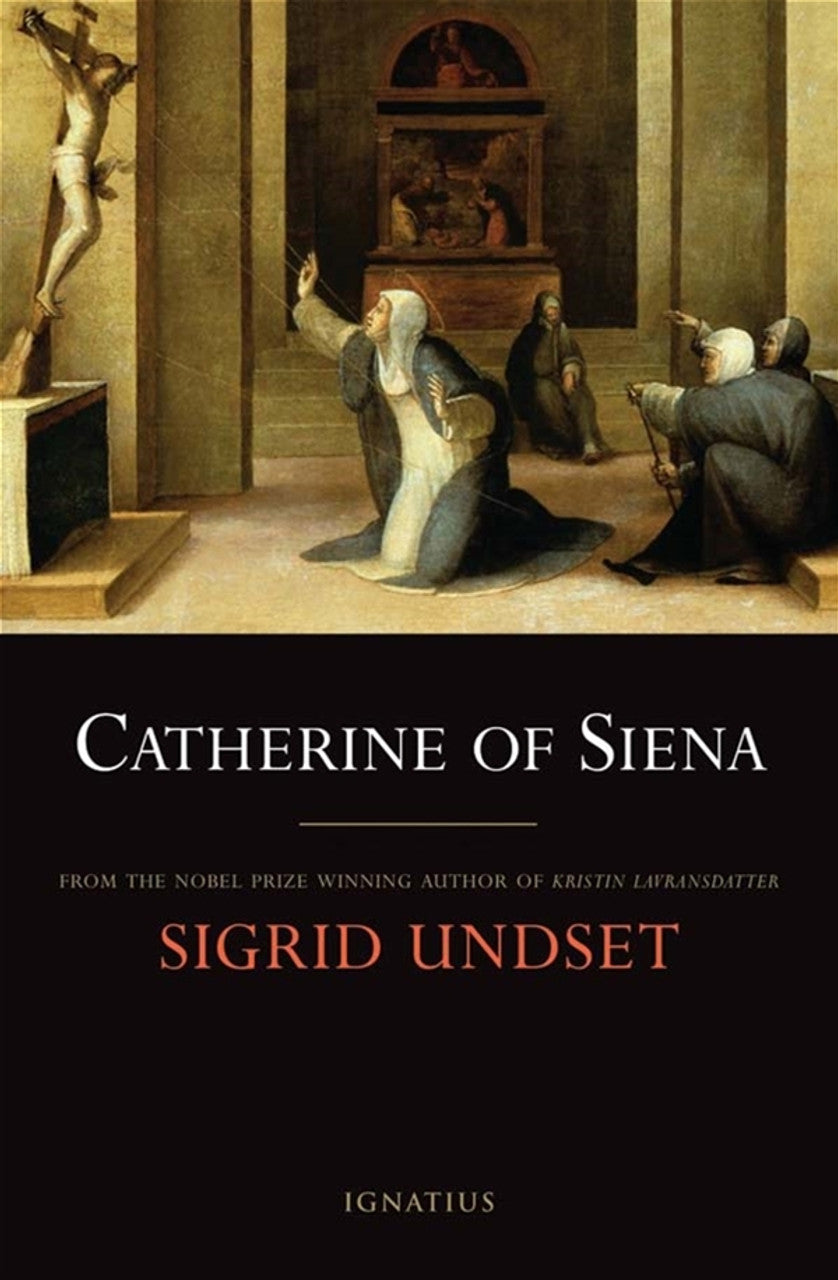
[[life-of-st-catherine-of-siena,the-secret-of-the-heart-st-catherine-of-siena-on-the-heart-of-jesus]]
But if the cell of self-knowledge is so necessary, why do we often resist it? Simply put: because it is uncomfortable. To face ourselves honestly means coming to terms with our sin, weakness, and need for God. Pride resists this. We tend to want to escape from it.
And we often can escape it with distractions.
Distractions, whether in St. Catherine’s day with “amusing books” or in ours with smartphones, streaming, and the constant churn of news, pull us out of that sacred space where God wants to meet us. While it is difficult, it is not impossible to put distractions aside and enter into a communion with God.
The truth is that if I am honest, I often prefer noise to silence. It can be hard to remain silent or enter into prayer when so many things are competing for my attention.
But it is because of those things that we need it more than ever today. Without silence, we lose the ability to see what is really happening in us, and to see Christ.
"If you look in murky and turbulent waters, you cannot see the reflection of your face. If you want to see the face of Christ, stop and collect your thoughts in silence, and close the door of your soul to the noise of external things." -St. Anthony of Padua
Again, the difference between self-awareness and self-knowledge is crucial. Self-awareness might tell me, “I talk too much in groups,” “I tend to procrastinate,” "I sometimes fill silence with noise". That’s useful, but it doesn’t tell me who I am. Self-knowledge places my anxieties, my tendencies, and my gifts in the light of God. It reveals that when we truly know ourselves and feel God’s love, we desire God more, and we begin to understand and act according to how God sees things.
“In self-knowledge, then, you will humble yourself, seeing that, in yourself, you do not even exist.”
(The Dialogue, ch. IV, ii, iv)
[[st-catherine-of-siena-world-on-fire-print,st-catherine-of-siena-framed-print]]
Helpful tools in the form of prompts for prayer
Most of us are already in constant conversation throughout the day, but it is often a conversation with ourselves. We narrate our worries, replay old conversations, rehearse what we should have said, and predict what might happen next. Even when we are trying to be “self-aware,” the interior monologue can become a kind of closed loop. The saints encourage us to build the habit of turning outward from ourselves and talking to God, not only in formal prayer, but in simple, ongoing ways throughout the day.
"The center of the soul has an unrestrainable need which demands satisfaction. In reality, God alone can answer this need and the only solution is to immediately take the road leading to Him. The soul must converse with someone other than itself. Why? Because it is not its own last end; because its end is the living God, and it cannot rest entirely except in Him." -Fr. Réginald Garrigou-Lagrange, O.P.
Maybe you are like me and have struggled at times with self-knowledge and with how to begin turning to God from that place. If so, "arrow prayers" (prayers lifted to God in a moment) can help. Below are 5 simple, focused prayer prompts you can use to enter that interior “cell” St. Catherine so beautifully describes:
1. Holy Spirit, illumine my heart so I may meet the truth of who I am in love.
2. My God, help me to see myself as I am.
3. Jesus, heal me from self-love and teach me humility rooted in Your mercy.
4. Lord, I bring you this sin of mine [name it]. Show me how it shapes me and set me free from its hold. Teach me to know myself more and to desire only You.
5. The Jesus Prayer (first prayed by the Eastern Desert Fathers): "Jesus Christ, Son of God, have mercy on me, a sinner".
St. Catherine teaches that self-knowledge without God can become exhausting, even dangerous. We either excuse ourselves or condemn ourselves. But when self-knowledge is rooted in God’s love, it becomes freeing and helps us to desire to seek God's Holy Will in all things.
In the Dialogue, St. Catherine is clear that self-knowledge is not meant to circle back into the self and become a kind of self-analysis. It is quite the opposite; it is meant to bring us to the point where we can say to God, "I need You for everything."
St. Catherine of Siena, pray for us!