
The Catholic Logic of the Cross
“Offer it up.” The phrase slips easily from Catholic lips, yet it encapsulates one of the most profound and misunderstood truths of our Faith: suffering has value. Jesus did not suffer so that we would never suffer; He suffered so that ours could be united to His and become redemptive
"For it has been granted to you that for the sake of Christ you should not only believe in him but also suffer for his sake." -Philippians 1:29
On the road to Heaven, the Cross is not an unfortunate detour; it is the bridge.
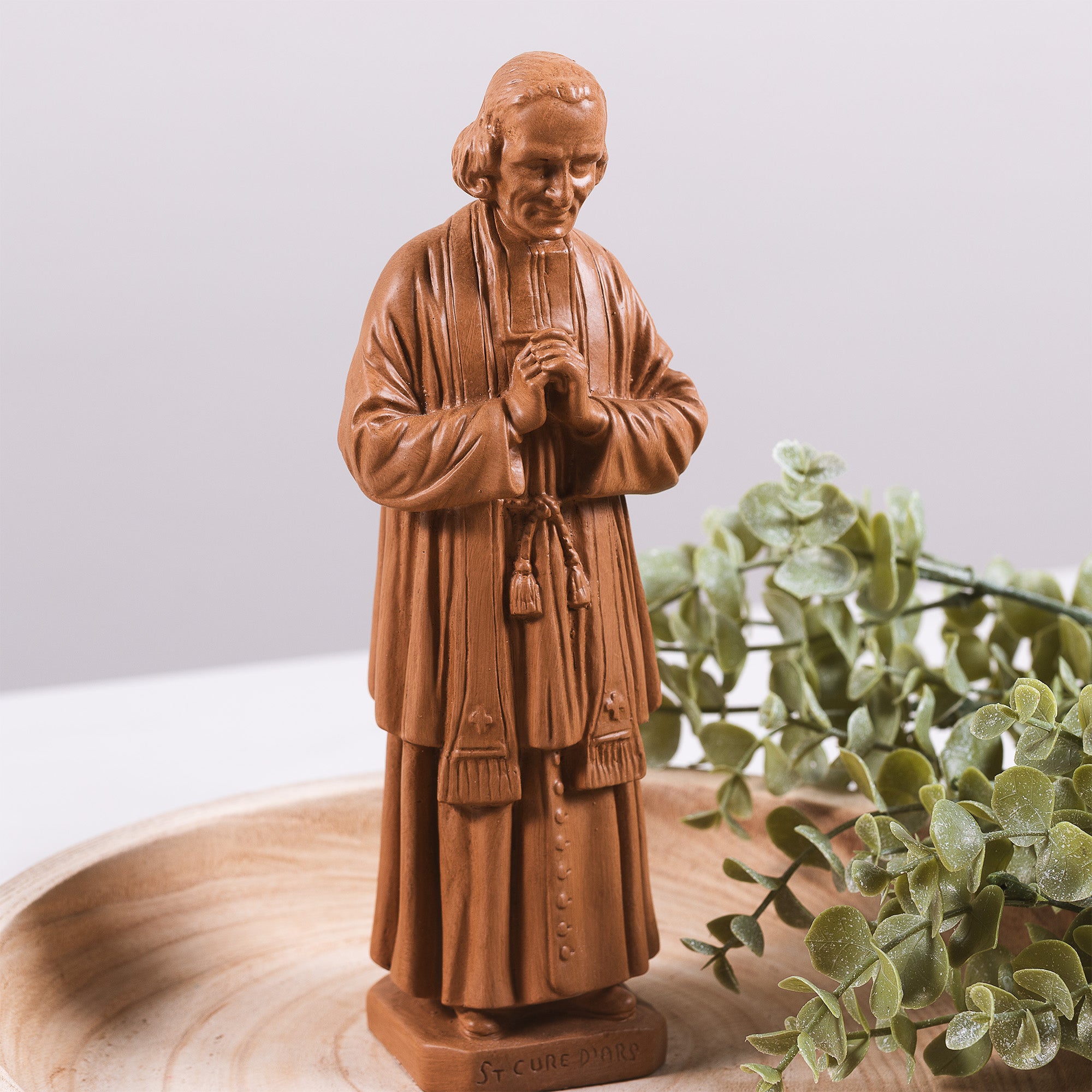
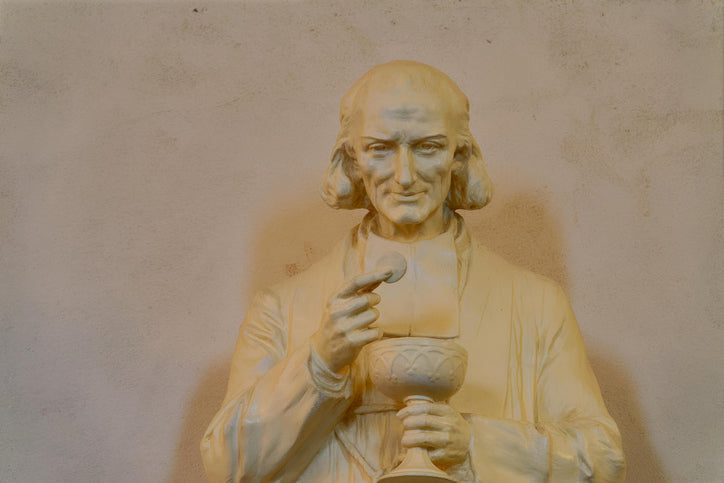
Few saints articulate this better than St. John Vianney (August 4), the humble Curé of Ars and patron of parish priests. He also embodies another virtue our noisy age desperately needs: simplicity, not simple-mindedness, but the temperate, single-hearted focus on what matters most: God and souls. I
“Whether We Will or Not, We Must Suffer”
St. John Vianney was blunt: everyone suffers. The difference is how we suffer. He contrasted the two thieves crucified beside Christ: one accepted his suffering “in the spirit of reparation” and heard, “This day thou shalt be with Me in Paradise”; the other railed against God and died in despair. For Vianney, there are only two ways to bear pain: with love or without it.
“There are two ways of suffering—to suffer with love, and to suffer without love.” -St. John Vianney
Love transforms the cross from a crushing weight into a ladder to Heaven. Without love, the same burden becomes bitterness. “Our greatest cross,” he said, “is the fear of crosses.” We flee, complain, or numb ourselves—yet the cross keeps pace. The wise go out to meet it, as St. Andrew did: “Hail, O good cross!”
By His Incarnation, Christ forever united Himself to our human condition, redeeming even our pain. When we consciously “offer it up,” we press our thorns and crosses to our hearts and let grace draw out their hidden sweetness. Suffering, carried in union with Jesus, becomes “the beginning of Heaven”—a participation in His redemptive love that purifies, detaches, and sanctifies.
Simplicity: Temperance Turned Toward the Essential
The first article taught us to accept suffering; the second invites us to shed excess. Simplicity is a daughter of temperance: it moderates our use of created goods, keeping only what we truly need to fulfill our vocation. The Latin simplicitas suggests naturalness, openness, frankness...being “real.”
Simplicity is not merely decluttering closets; it declutters the heart. Disordered attachments fragment us. We become complicated, manipulative, and overextended. Scripture praises the “simple and upright” Job (Job 1:1) and the guileless Nathaniel (Jn 1:47), while Jesus condemns the Pharisees’ duplicitous hearts (Mt 23:4). Simplicity frees us from the heavy burdens we strap to our own backs.
“Simplicity is nothing but an act of charity pure and simple, which has but one sole end—that of gaining the love of God.” —St. Francis de Sales
A Life Poured Out: The Story of Jean-Marie Vianney
Born to a peasant family near Lyon in 1786, Jean-Marie Vianney grew up amid the French Revolution’s anti-Catholic fury. He received First Communion in a barn; priests were hunted; churches shuttered. His childhood was shaped by the persecutions and clandestine heroes served to fire John Vianney's imagination. He prayed the Rosary in the fields, setting a little statue of Our Lady in a tree hollow and keeping her company all afternoon.
Vianney discerned the priesthood early, but revolutionary chaos left him poorly educated. He struggled with Latin and philosophy. Many of his classmates mocked him, and even some of his professors doubted him. When his fitness for ordination was questioned, the Vicar General asked one decisive question: “Does he say his beads?” Hearing of the young man’s deep Marian devotion, he concluded, “Then I will receive him, and God’s grace will do the rest.” At thirty, Vianney was ordained.
Ars: A Backwater Set Ablaze
After serving briefly with his beloved mentor Fr. Balley, Vianney was sent to Ars, a hamlet of forty mud houses steeped in ignorance and vice. His “strategy” was breathtakingly simple: perpetual adoration, fervent preaching, relentless intercession. He catechized with Rosaries, converted with tears, and thundered against drunkenness and Sabbath-breaking. Far from repelling the villagers, his authenticity drew them in. Soon, the church overflowed; a chapel had to be added.
Word spread and penitents poured in, 80,000 a year by some estimates. The Curé spent up to twenty hours a day in the confessional, snatching only two hours’ sleep. “From this time forth,” wrote his biographers, “he never had one hour he could call his own.”
Simplicity in Action: Providence, Poverty, and Peace
He founded an orphanage, La Providence, with no money at all—just trust. When bills came due, he’d walk with his Rosary and “mysteriously” meet a benefactor with the exact sum. Demons tormented him nightly; he shrugged and offered the lost sleep for sinners.
He endured envy and calumny from fellow clergy who called him an ignorant fanatic. His response? “It is the cross that gives peace to the world! All our misery comes from not loving it.”
A pilgrim, asked why he traveled to Ars, replied: “Of human learning, no—but of divine learning, oh yes. In him I saw a little child, and therefore God is with him.” That childlike simplicity—utter transparency to God—was his secret.
Vianney died in 1859, after forty years in Ars. He had one thought, said a friend: “to love God and make Him loved.”
Putting Simplicity Into Practice
St. John Vianney lived a simple priesthood. He did nothing more spectacular with his life other than to preach, hear confessions, and offer the Holy Sacrifice of the Mass. He simply became what he was meant to be: another Christ. Yet his simplicity was his grandness, and this imbued his life with Divine power.
Like John Vianney, we have a vocation that we are called to live out in this world, and we do not have to make it complicated by trying to be or do more than God has made us to be. As St. Therese of Lisieux said, “He cherishes simplicity.”
How can we begin to practice the virtue of simplicity?
First, we can set our hearts in order by taking inventory of our lives and seeing where we have accumulated unnecessary “baggage” that hinders us from pursuing God with a whole and undivided heart. Then we can begin to detach ourselves from these things so that our heart can be free to love God and others as we are meant to, instead of having to maintain and care for all the unnecessary things we have accumulated.
What areas of our lives feel bloated and hard to manage, leaving us frazzled and worn out? How many clothes and shoes do we have in our closets, and do we need them all? How much time do we spend using electronic devices? How many activities are we and our families involved in? Can we reduce them and spend more time together at home?
Many of us are not satisfied with who we are or what we have, and we complicate our lives by pursuing things we do not need. However, we can strive to be content with less and can become whole again by cutting the ties that bind our hearts and our souls. St. John Vianney lived the virtue of simplicity, and this was his path to sanctity.
The following are seven lessons in sanctity that we can learn from the Cure of Ars:
1. Suffer With Love, Not Resentment
St. John Vianney knew the truth that pain visits every life. He would counsel his flock to meet it as Simon did when he carried the Cross, shoulder to shoulder with Jesus, rather than as the bad thief.
2. Fear of the Cross; Heavier Than the Cross Itself
We all can relate to the idea that anxiety about suffering often magnifies it. One way that St. John Vianney dealt with it was to ask for the love of crosses. He explained that when we ask the Lord to allow us to love our crosses, we will discover joy.
3. Simplicity Is Strength, Not Stupidity
St. John Vianney was no simpleton. He lacked academic brilliance but possessed supernatural wisdom. This reveals how simplicity sharpens focus; it doesn’t dull the mind.
4. Detach to Be Free
Take note of your attachments, your possessions, screens, busyness, and ego-projects. What clutters your heart? Simplicity helps us to create interior space for God.
5. Let Providence Provide
Live your vocation faithfully and trust God with the “how.” St. John Vianney’s peace and joy came from his trust in the providence of God.
6. Offer, Don’t Waste, Your Trials
In the life of St. John Vianney, insomnia, misunderstandings, failure, illness, or any other suffering, were never meaningless when given to Christ. “A cross carried simply…is no longer a cross.”
7. Holiness Is Doing the Ordinary, Totally for God
St. John Vianney preached, confessed, and said Mass...again and again and again. The consistent fidelity of his life and all that it encompassed revealed his sources of sanctity. We can learn from him as lay people who prioritize a sacramental life.
Prayer to St. John Vianney
St. John Vianney, faithful Curé and lover of the Cross, teach us to suffer with love and live with holy simplicity. Obtain for us the grace to strip away what is unnecessary, to welcome the crosses God permits, and to offer everything for love of Jesus and the salvation of souls. Amen.
St. John Vianney, pray for us.