
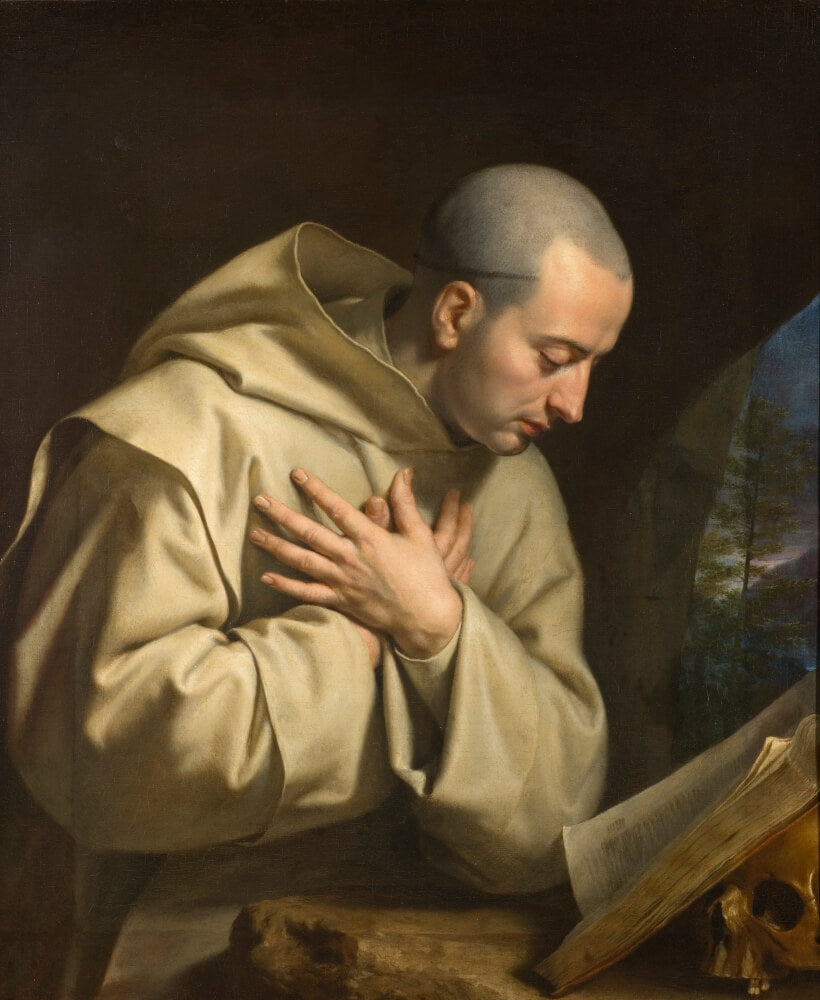
“God's first language is silence. Everything else is a poor translation.”— St. John of the Cross
In a world saturated with noise, the very idea of silence can feel like a distant dream. We are constantly bombarded with information, entertainment, and the incessant chatter of our own minds. Yet, deep within the human spirit, there lies a profound longing for stillness, for a quiet space where we can encounter the divine. The feast of St. Bruno of Cologne, celebrated on October 6th, serves as a powerful reminder of this essential truth. His life and the monastic order he founded, the Carthusians, are a testament to the transformative power of silence in a world that has all but forgotten its language.
The Call of the Desert
Born in Cologne around 1030, St. Bruno was a distinguished scholar and teacher. He was the rector of the cathedral school at Reims, a prestigious position that promised a comfortable and influential life. However, Bruno felt a deeper calling, a yearning for a life wholly dedicated to God, far from the distractions and ambitions of the world. At the age of 54, an age when many would be looking towards retirement, Bruno embarked on a radical new path. Along with six companions, he sought out St. Hugh, the Bishop of Grenoble, with a simple yet profound request: to live in a solitary place, a desert where they could devote themselves to a life of prayer and contemplation.
St. Hugh, who had seen in a dream seven stars leading him to a remote valley, recognized the divine providence in Bruno's request. He led them to the desolate valley of Chartreuse, a place of stark and rugged beauty in the French Alps. There, at an altitude of over 4,000 feet, surrounded by towering peaks and blanketed in snow for much of the year, they built their first hermitage. It was a place of profound silence, where the voice of God could be heard in the whisper of the wind and the stillness of the mountains.
The Carthusians: An Unbroken Tradition
The order founded by St. Bruno, the Carthusians, is unique in the history of the Church. It is the only ancient monastic order that has never needed to be reformed. Their way of life, a blend of solitary and communal living, has remained virtually unchanged for over 900 years. The Carthusian motto, Stat Crux dum volvitur orbis (“The Cross is steady while the world is turning”), perfectly encapsulates their mission. They are a still point in a constantly changing world, a silent witness to the eternal reality of God.
Carthusian monks and nuns do not engage in active ministry. They do not preach, teach, or run parishes. Their life is one of hidden prayer and penance, a silent offering for the salvation of the world. As Cardinal Robert Sarah has written, “By living with the silent God, and in Him, we ourselves become silent.” The Carthusians embody this truth, their lives a continuous prayer, a silent communion with the divine.
The Eye of the Hurricane
Tim Peeters, in his book called When Silence Speaks, describes the Carthusians as the “eyes of the hurricane.” They are "pockets of profound stillness amidst the storms of the world". This powerful image reminds us that even in the midst of chaos and turmoil, there is a place of peace and tranquility to be found. This place is not necessarily a remote monastery in the Alps, but the silent sanctuary of our own hearts.
St. Bruno himself was not always able to live in the solitude of Chartreuse. In 1090, he was summoned to Rome by his former student, Pope Urban II, to serve as his advisor. Though he longed for the silence of the mountains, Bruno obediently served the Pope. Yet, even in the midst of the busy papal court, he never abandoned his search for silence. He sought out quiet moments for prayer and contemplation each day, a testament to his unwavering commitment to his vocation.
Eventually, the Pope allowed Bruno to establish a new hermitage in Calabria, in southern Italy. There, he founded the monastery of Santa Maria della Torre, where he lived until his death in 1101. His life teaches us that it is possible to cultivate a spirit of silence and contemplation even in the midst of a busy and demanding life.
Finding Silence in a Noisy World
The feast of St. Bruno is an invitation to examine our own lives and our relationship with silence. In a world that glorifies noise and distraction, we must be intentional about creating space for quiet in our lives. This can be as simple as turning off the radio during our commute, spending a few minutes in silent prayer each morning, or making a regular visit to a local Adoration chapel. We don't need to live in the Grand Chartreuse in France to cultivate silence in our lives.
As Cardinal Sarah reminds us in The Power of Silence: Against the Dictatorship of Noise, “A man without silence is a stranger to God, exiled in a distant land that remains at the surface of the mystery of man and the world.” The journey into silence is a journey into the heart of God. It is a path that leads to a deeper relationship with Him and a more profound understanding of ourselves.
On this feast of St. Bruno, let us ask for his intercession that we may have the courage to embrace silence, to seek out the “still point of the turning world,” and to discover the transformative power of a life lived in communion with God.
St. Bruno, pray for us!