Most Catholics would say you'd be hard-pressed to find a devotion more cherished than the rosary. In fact, it has become so associated with Catholicism that even many non-Catholics are familiar with it, even if only through TV and movies.
The gentle jingling of the elegant strand of beads is often associated with our Faith, but what is the history of this beloved devotion, and what are the different types of Catholic rosaries?
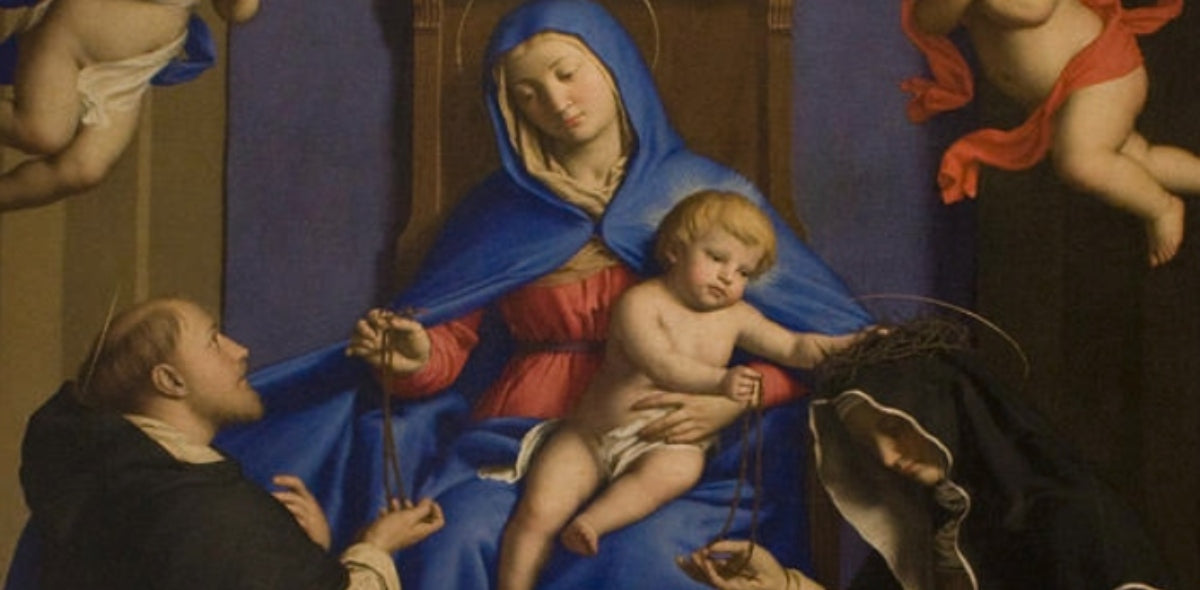
St. Dominic Receiving the Rosary from Our Lady by Unknown Italian Artist (17th C.)
Origins of this Powerful & Beloved Devotion
History yields different accounts of the origins of the rosary, but it likely began in medieval times, when many of the faithful could not read, or afford to purchase a Psalter, the book containing the 150 Psalms used for daily prayer by religious orders and clergy.
Traveling priests wanted to provide an easily accessible means of prayer to help people remain fixed on the life and love of Christ and the humble and trusting example of Mary.
Itinerant preachers developed and encouraged the use of these special prayers, and St. Dominic de Guzman, Founder of the Dominican order, first popularized the rosary in a form similar to what we pray today.
Tradition holds that Our Lady appeared to St. Dominic, encouraging him to pray this way in response to the Albigensian heresy. For this reason, the most common and traditional form of the rosary is also known as the Dominican rosary.
At first, it was prayed with pebbles from a bag, and later, a string containing knots or beads. The use of prayer beads dates back to pre-Christian times and is common among many world religions. Each bead represented a prayer: either the Lord's Prayer, the Hail Mary, or the Glory Be, also known as the Doxology. In time, other prayers were composed and added.
[[genuine-connemara-marble-irish-rosary, 8074]]
It was originally known as the Psalter of Jesus & Mary, because it consisted of the Our Father, the Prayer Jesus taught us, and the Hail Mary, the greeing of the Archangel Gabriel to Our Lady. Both of these are revealed in Scripture.
When prayed completely, the original rosary (Joyful, Sorrowful, and Glorious Mysteries) featured 150 Hail Marys, which corresponded to the Psalter's 150 Psalms. Later, the Church added the Luminous Mysteries to complete the rosary as we know it today.
Of Roses & Beads
The word "rosary" comes from the Latin word rosarium, a garland or bouquet of roses. The prayers of the rosary are meant to be an offering - and the beads a garland of love - to Jesus and Mary.
The word "bead" comes from the Old English word "biddan" which means to pray or entreat.
The rosary combines two very strong elements of our formation in the Faith. First, by revealing the life of Christ in all its mystery and love, the rosary allows us to know Him, unite ourselves to Him, and enter into deeper love and faith with Him.
Then, by emphasizing Mary's unique and essential role in our salvation, the rosary prompts us to see salvation history through her eyes. As we do, we grow to trust and love Christ's Mother, who is also our Mother, taking her as a model of faith, hope, and love.
[[aqua-rose-bead-rosary, rose-shaped-wood-bead-wall-rosary]]
When we pray the rosary, these two essential elements of Roman Catholic theology become an intimate part of our spirituality - and lead us into an intimate relationship with Jesus and Mary.
Church History & the Rosary
In 1520, Pope Leo X officially approved the universal use of the rosary. In 1570, Pope St. Pius V established the original 15 Mysteries of the rosary. In 1571, after the victory of Christendom over Islamic invaders at Lepanto, he declared the first Feast of the Holy Rosary. This was made universal by Pope Clement XI in 1708.
In 1917, the Blessed Mother selected for herself the name "Our Lady of the Rosary" at Fatima when she appeared to the three shepherd children.
In 2002 Pope John Paul II introduced new mysteries, the Mysteries of Light, or Luminous Mysteries to the Rosary and wrote his apostolic letter "On the Most Holy Rosary" (Rosarium Virginis Mariae).
Mary has encouraged us to pray her rosary devotedly. At Lourdes, she prayed it with St. Bernadette. At Fatima, she commanded the children, “Say the rosary every day to obtain peace in the world.” Later, to Sr. Lucia, the Fatima seer, she said, “There is no problem so great that it cannot be solved by the Rosary.”
[[pray-the-rosary-expanded-edition, 34304]]
Tradition holds that when Our Lady appeared to St. Dominic she made this powerful promise,
“One day, I will save the world through the Rosary.”
Other Forms of the Rosary
There are other rosaries in addition to the traditional (Dominican) form. Though they differ, each has its origin in the desire to know and honor the life of Christ and His mother as we immitate them, and ask their intercession.
Paternoster Beads
In ancient times, monks and priests prayed the Divine Office daily in Latin, which was the liturgical language of the Western Church. They recited or chanted the 150 Psalms as a source of hourly worship. To count these repetitions they used beads, which they strung on cords and carried. These became commonly known as Paternosters, from the term "Pater Noster," which is Latin for "Our Father."
Lay brothers or those who did not know Latin were required to say the Our Father 150 times each day while meditating on the mysteries of Christ's life. Over time, laypeople adopted the practice as a form of piety and worship.
The faithful made paternosters in various lengths, but one containing 50 beads became popular, allowing them to circle it three times during prayer.
[[jesus-beads, black-leather-rosary-pouch-with-gold-lettering-zipper]]
This form of prayer is still used by some in the Eastern and Western Churches, and by Anglicans. It generally involves repetition of the Apostles Creed, Lord's Prayer, and Hail Mary, so it may be one of the earliest forms of Christian prayer using the beads or knots to which we are accustomed.
Brigittine Crown
Propagated by St. Brigitte of Sweeden, this rosary features six mysteries within the decades, adding the Immaculate Conception to the Joyful Mysteries, Receiving Christ from the Cross to the Sorrowful Mysteries, Entry into Jerusalem to the Luminous Mysteries, and Mary as the Matron of the Brigittine Order to the Glorious Mysteries.
Prayed by the Brigittine Order and and worn on their habits, it is also prayed and worn by the Discalced Carmelites, after Brigittine nuns in Spain hosted St. Teresa of Avila as she traveled to reform her order and establish Discalced Carmelite monasteries. The final Glorious Mystery as prayed by the Carmelites honors Our Lady as Queen of the Carmelite Order.
Carthusian or Life of Christ Rosary
Dominic of Prussia was a Carthusian monk and spiritual writer devoted to the rosary. According to St. Louis de Montford's writings, the holy monk initiated the Carthusian rosary after a vision of heaven opening in grandeur, while saints and angels prayed the rosary in honor of the life of Christ.
Unlike the Dominican rosary, where different mysteries are prayed according to the days of the week, this rosary contains 50 mysteries of the life of Christ, composed by Dominic of Prussia, prayed every day, with each ending in a Hail Mary and special invocation. The five decades cover the Birth, Youth & Ministry, Passion, Crucifixion, and Resurrection of Jesus.
Other prayers including the Apostles Creed, the three Hail Marys, Our Father, Hail Holy Queen, and Fatima Prayer are included in the recitation, along with a prayer to Our Lady composed by the Carthusian monk.
his rosary was officially established in 1422 and contains seven decades, honoring the Seven Joys of Mary, and how she responded to the grace of God during each of these instances in her life. Also called the Seraphic Rosary, it includes meditating on the Annunciation, Nativity, Adoration of the Magi, Resurrection, Ascention, Pentecost, and her Corronation, overlapping with the Joyful and Glorious Mysteries of the Dominican rosary.
Not only did the Franciscans develop and propagate this rosary as a part of their spirituality, but they are credited with adding the final words to the Hail Mary in its current form, "Holy Mary, Mother of God, pray for us sinners now and at the hour of our death."
[[immaculate-heart-of-mary-cause-of-our-joy-candle, our-lady-of-guadalupe-rosary-holder]
Servite Rosary or Seven Sorrows Rosary
In 1233 a confraternity of men honoring Mary, Mother of God gathered in prayer in Florence, Italy. Tradition holds that Our Lady appeared to them, asking them to retire from the world as a community, and offer themselves for her service. They traveled to Monte Senario near Florence and established the Servites, or Order of the Servants of Mary.
They began to venerate Our Lady of Sorrows,developing the Seven Sorrows Rosary as a part of their spirituality. The Seven Sorrows include the Prophecy of Simeon, Flight into Egypt, Loss of Jesus in the Temple, Meeting Jesus on His Way to Calvary, Standing at the Foot of the Cross, Receiving the Body of Jesus, and Jesus is Placed in the Tomb.
Each of these Sorrows constitutes a decade (though the "decade" contains seven, not ten Hail Marys). Other prayers are also included in the Servite Rosary. The introductory prayers were written by St. Alphonsus Liguori.
[[st-peregrine-rosary-2001932, collectors-edition-st-jude-rosary]
Trisagion or Trinitarian Rosary
The Order of the Most Holy Trinity for the Redemption of Captives, founded in France in 1198, required that one-third of the income of the members be used to purchase the freedom of captives who had fallen into the hands of slavers or pirates. This order introduced the Trisagion (from the Greek for "thrice holy") in praise of the Holy Trinity.
The detailed history of this Byzantine prayer is unclear, but it may date back to the beginning of the Order. It features three groups of nine beads each, where each group is preceeded by the Trisagion prayer, "Holy God, Holy Strong One, Holy Immortal One, have mercy on us."
A specific prayer to the Holy Trinity is prayed on each of the nine beads rather than the Hail Mary prayed in the Dominican rosary. Each "decade" group (of nine beads in this rosary) ends with a Glory Be. A closing prayer completes the Trinitarian rosary.
Though these rosaries differ in many ways, they share important themes honoring Our Lord, Our Lady, the Holy Trinity, and more. To meditate repeatedly on the Mysteries of our salvation is a way to grow in knowledge of Christ and Mary.
Devotion to the rosary nourishes the soul and increases faith. The rhythmic recitation of the prayers promotes serenity and interior recollection that can bring about other spiritual fruit.
The key events in the lives of Jesus and Mary contain precious lessons and truths for us. Learning these and contemplating them, we unite ourselves to Christ, and are inspired to continue seeking Him as we grow in holiness, despite the challenges of our lives.
By spending time in the life of Jesus and Mary, our faith in God is increased, so that we can trust in His will for us. We strengthen our hope in the heavenly reality that awaits us beyond this world. We grow in humility. We receive and believe in His mercy, and we honor the incredible gift of our salvation.
Meditation on the Mysteries brings forth spiritual change - in behaviors, in habits, and in the heart. All of these things nurture our continued conversion. Praying the rosary, we make a loving act of gratitude through which our hearts are enlarged and filled with the love of Christ and Mary.
[[brilliant-blue-crystal-rosary-bracelet-1, tau-wood-bead-rosary-bracelet]]
Devoting ourselves to the rosary, we grow in our desire for holiness, that nothing may separate us from Him. We receive the graces we need to be holy. We gain the courage and capacity to suffer in imitation of His example, and to offer our sufferings in participation and union with His.
A Communal Prayer
Despite its profound effect on the soul, the rosary was not meant only as an individual devotion. Its fruits are far too great for that. It is intended to influence society as a whole. Our Lady has told us this. Several papal encyclicals speak of the social consequences the rosary can procure or prevent.
Examples from the lives of Jesus and Mary are meant to be our models, our antidotes, our weapons and remedies against the errors and depravity afflicting our world. Recitation of the rosary for the Church, the World, for sinners, and our own intentions is the path to holiness, peace, and healing, not just individually, but collectively.
This is the dignity, power, and inestimable treasure of the most holy rosary.