
As we approach the 250th anniversary of our republic, it is a fitting time to reflect with gratitude upon the principles that shaped our nation. Among the most cherished is religious liberty: the freedom to worship according to one's conscience without interference from the government.
That freedom was not guaranteed to many early Cathlolics. Long before the Declaration of Independence and the First Amendment, Catholics in England faced legal restrictions, social discrimination, and political suspicion because of their faith.
Their struggle to escape persecution and obtain religious freedom would eventually lead some to seek a new life in America, helping lay the groundwork for one of our country's most enduring ideals.
The Challenges Facing Catholics in England
For centuries, England had been a Catholic nation. That changed dramatically in the sixteenth century when King Henry VIII broke with Rome and established the Church of England.
Over time, Catholics lost access to many opportunities. They were often barred from public office, faced limits in education, and lived under suspicion because of their loyalty to the pope. Priests frequently ministered in secret, celebrating Mass in private homes rather than public churches.
The situation intensified during the reign of Queen Elizabeth I, which began in 1558. Under her rule, the English government imposed strict Protestant conformity through penal laws, fines, and other restrictions. Catholics who refused to attend Anglican services could face heavy financial penalties, imprisonment, and exclusion from public life.
For Catholic priests, the consequences could be even more severe. Following legislation enacted in the late sixteenth century, priests who entered England from abroad could be charged with treason, imprisoned, tortured, and executed.
Those who harbored or assisted priests also risked severe punishment. As a result, Mass was often celebrated in secret, and many Catholic families concealed priests in hidden rooms known as "priest holes." Despite the risks, many families remained faithful and passed their beliefs on to future generations.
[[norman-rockwell-freedom-of-worship-framed-print-8-x-10, ghirelli-limited-edition-the-united-states-250th-anniversary-rosary]]
Why Some Catholics Looked to the New World
For Catholic families, the promise of America was about more than land or economic opportunity.
The New World offered the possibility of practicing the faith with greater freedom and security. It represented a chance to build communities where Catholics could participate more fully in public life while remaining faithful to their beliefs.
Not all Catholics left England, but those who did faced tremendous risks. The journey across the Atlantic was dangerous, and life in the colonies was uncertain, but the hope of greater religious freedom motivated many to make the voyage.
By the early seventeenth century, Catholic leaders began searching for a place where English Catholics could practice their faith more freely while remaining loyal subjects of the Crown. Their efforts would eventually lead them to Maryland, one of the most significant Catholic settlements in colonial America.
[[pray-strong-prayer-card, come-rack-come-rope]]
The Road to Maryland
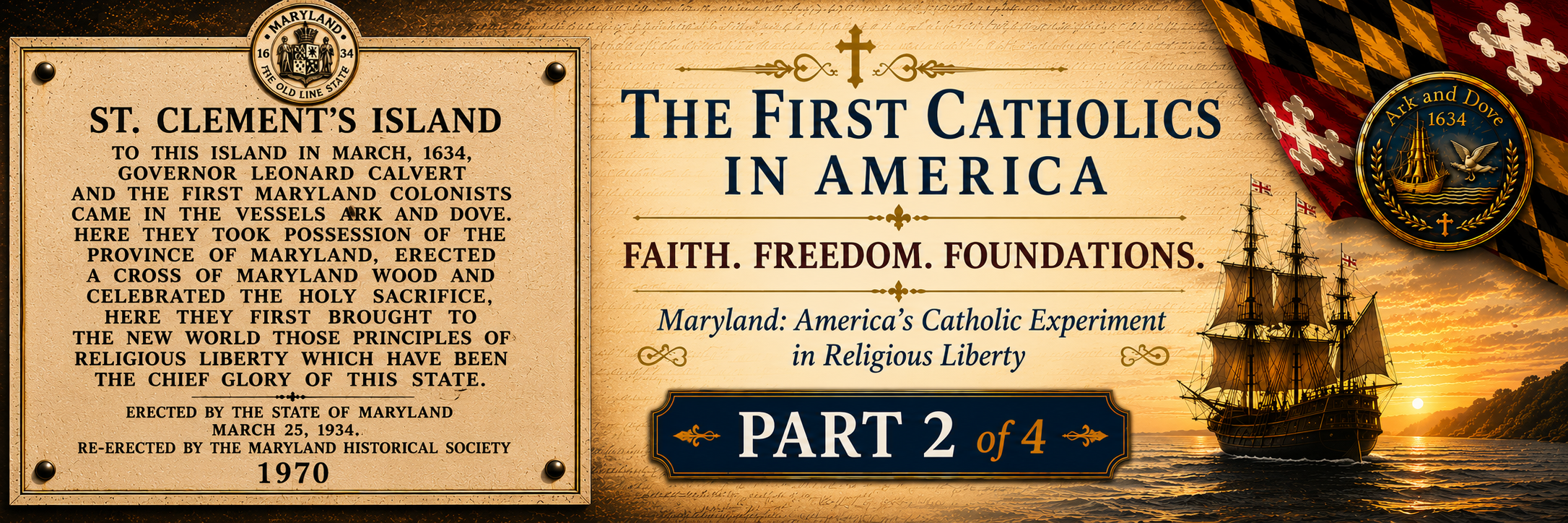
The vison for Maryland, one of the most important centers of Catholic life in early America, began to take shape in 1634. On March 25 of that year, the first English Catholic settlers arrived under the leadership of Leonard Calvert, who became their first governor.
Sailing aboard the Ark and the Dove, they landed on St. Clement's Island in Southern Maryland. On that same day, Jesuit Father Andrew White celebrated the first Roman Catholic Mass in the colonies.
The settlers began establishing a colony that offered Catholics greater opportunities, all of which were unavailable to them in England. Together they began to live and practice their Faith. They could finally own land, build communities, participate in civic life, and worship with greater openness.
Fifteen years later, in 1649, Maryland adopted the Maryland Toleration Act. The Act was one of the earliest laws in the English-speaking world that provided legal protection for all Trinitarian Christians in the practice of their religions.
Though it was imperfect by modern standards, it represented an important step toward the principle of religious liberty that would later become a cornerstone of the American experiment.
The Early Catholic Contribution to Religious Freedom
The experiences of Catholics in England gave them a deep appreciation for the importance of religious freedom. Having lived under restrictions themselves, many Catholic settlers understood the dangers of allowing government power to dictate matters of faith.
Their experience of persecution helped shape the earliest efforts to promote religious toleration in colonial America. The idea that people of different faith traditions could live together peacefully was not universally accepted in the seventeenth century, yet it became an important part of the American story.
Maryland would also become home to families whose descendants helped shape the United States itself.
In our next article, we will explore the founding of Maryland, and how a Catholic vision of religious toleration helped influence the American experiment in liberty.
[[u-s-pledge-of-allegiance-garden-flag,american-patriot-hoodie]]
Remembering the Roots of Religious Freedom
As we celebrate 250 years of American independence, it is worth remembering that religious liberty did not emerge overnight. It was shaped by generations of men and women who understood firsthand what it meant to live without it.
These early settlers suffered greatly for their ideals, sacrificed for them, and committed them to action - in a free country that became the United States of America.
The story of Catholic history in America begins not with power or privilege, but with these courageous men and women who left everything behind to travel to a new world to live their Faith freely.
Read Next: St. Anne Line: English Martyr, Protector of Priests & Seminarians