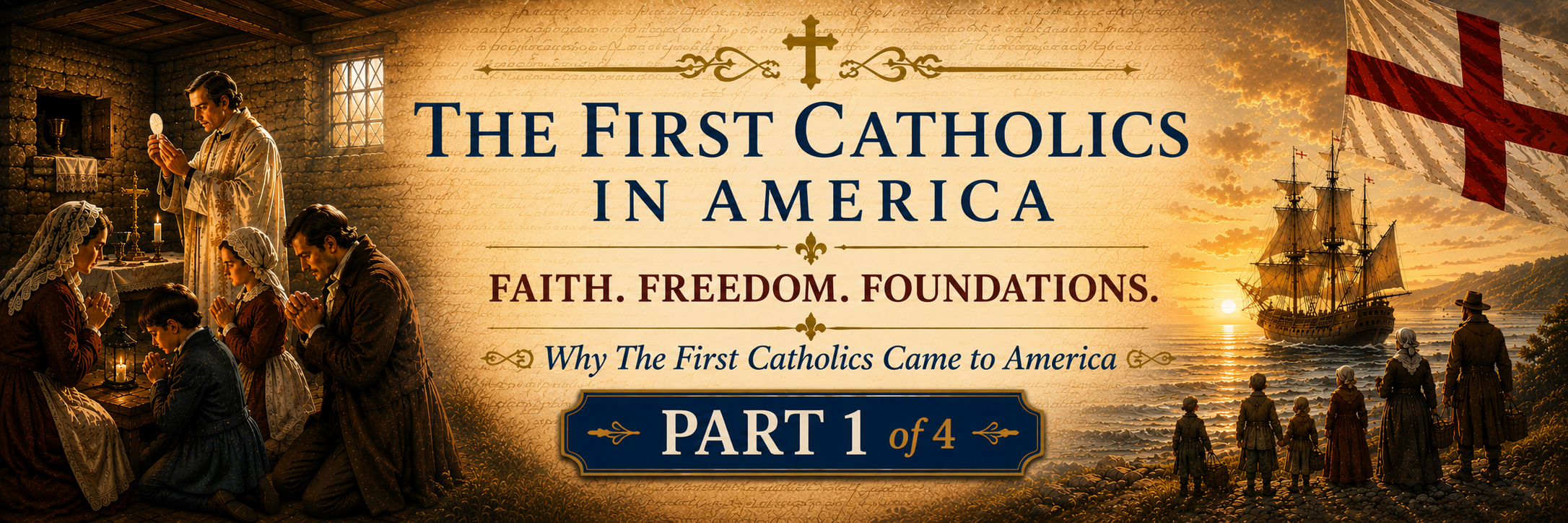

In our previous article, we explored why many English Catholics sought greater religious freedom in the New World. For many, that search led to Maryland, a colony that became one of the most important centers of Catholic life in colonial America.
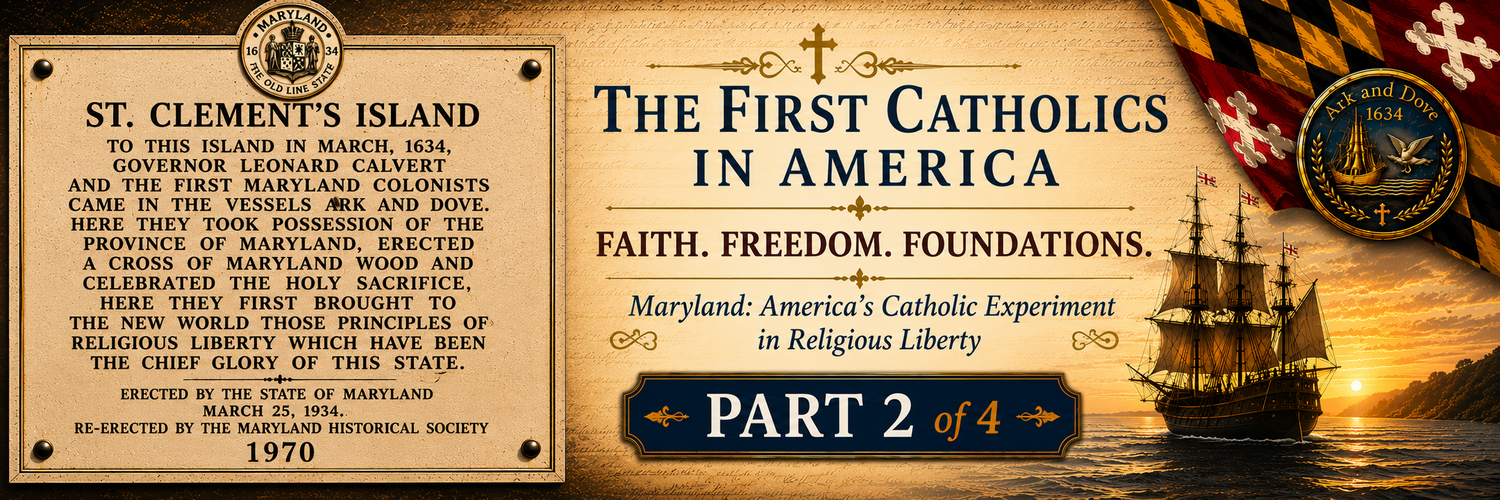
Founded in 1634, Maryland was more than a settlement. It was an ambitious experiment in religious coexistence at a time when Europe was deeply divided by religious conflict.
While Catholics had faced legal restrictions, social discrimination, and even persecution in England, Maryland offered the possibility of a different future.
The Vision of the Calvert Family
The driving force behind Maryland was the Calvert family. George Calvert, the first Lord Baltimore, had converted to Catholicism and experienced firsthand the challenges Catholics faced in England.
Seeking a place where Catholics could live with greater freedom while remaining loyal subjects of the English Crown, he proposed the establishment of a new colony in North America. Although he died before his dream became a reality, his son, Cecilius Calvert, the second Lord Baltimore, carried the project forward.
In March 1634, settlers arrived aboard two ships, the Ark and the Dove, under the leadership of Leonard Calvert, Cecilius' brother and Maryland's first governor. They landed on St. Clement's Island in present-day Southern Maryland, and established the settlement of St. Mary's City.
The colony's name also reflects its Catholic heritage. Maryland was named in honor of Queen Henrietta Maria, the Catholic wife of King Charles I of England. Contrary to what many assume, the colony was not officially named after the Blessed Virgin Mary.
Even so, Catholics have long appreciated the providential connection between the colony's name and Our Lady, especially given Maryland's role as a refuge for Catholics seeking greater religious freedom in the New World.
Soon after arriving, Fr. Andrew White, a Jesuit priest and one of the settlers, celebrated a Mass of thanksgiving for the weary pilgrims, marking one of the earliest recorded Catholic Masses in the English colonies.
[[pray-for-our-nation-burlap-flag,god-bless-america-250th-commemorative-old-glory-t-shirt]]
What Made Maryland Different?
Maryland was never intended to be an exclusively Catholic colony. Instead, the Calverts envisioned a society where Catholics and Protestants could live together peacefully under the law.
In the seventeenth century, this was a remarkably bold idea. Across Europe, religious differences frequently led to discrimination, political instability, and even war.
Maryland sought a different path. Catholics could worship openly unlike they had in England. They could own land, participate in public life, and build stable communities. Families established farms, businesses, and parishes while helping develop the young colony.
Life there was far from easy. All early settlers faced disease, harsh conditions, economic uncertainty, and occasional religious tensions. Still, Maryland offered opportunities that many Catholics could scarcely have imagined a generation earlier.
The Maryland Toleration Act
One of Maryland's most significant contributions to American history came in 1649 with the passage of the Maryland Toleration Act. The law provided legal protection for Christians who professed belief in the Trinity. Although it did not grant full religious freedom as Americans understand it today, it represented an important step toward the principle that people should not be persecuted for their religious beliefs.
By modern standards, the act was limited. Yet in a world where religious conflict was common, it was a remarkable development. The Toleration Act reflected a growing recognition that civil society could function without forcing complete religious uniformity.
[[a-prayer-for-our-troops-prayer-card,god-bless-america-250th-commemorative-candle]]
The Catholic Roots of Religious Liberty
Maryland's importance extends beyond its colonial history. The colony demonstrated that people of different Christian traditions could live and work together despite their theological differences. The lessons learned there helped shape broader conversations about religious freedom in America.
More than a century before the First Amendment guaranteed the free exercise of religion, Maryland offered an early example of what religious toleration actually looked like in practice. Its Catholic founders understood from experience the dangers of religious persecution. Their efforts helped plant seeds that would later flourish in the American commitment to religious liberty.
Maryland's Lasting Legacy
The story of Maryland is not simply the story of a colony. It is the story of an idea. It is the story of brave men and women who crossed an ocean seeking the freedom to live their Faith and who worked to build a society where religious differences did not lead to oppression.
That legacy would extend far beyond Maryland's borders. In the generations that followed, Maryland's Catholic community produced some of the most influential figures in American history, including Charles Carroll of Carrollton, the only Catholic signer of the Declaration of Independence; Daniel Carroll, a signer of the Constitution; and John Carroll, America's first Catholic bishop and founder of Georgetown University.
Their achievements helped shape the United States, but their story begins here, in a colony founded on the hope that faith and freedom could flourish together.
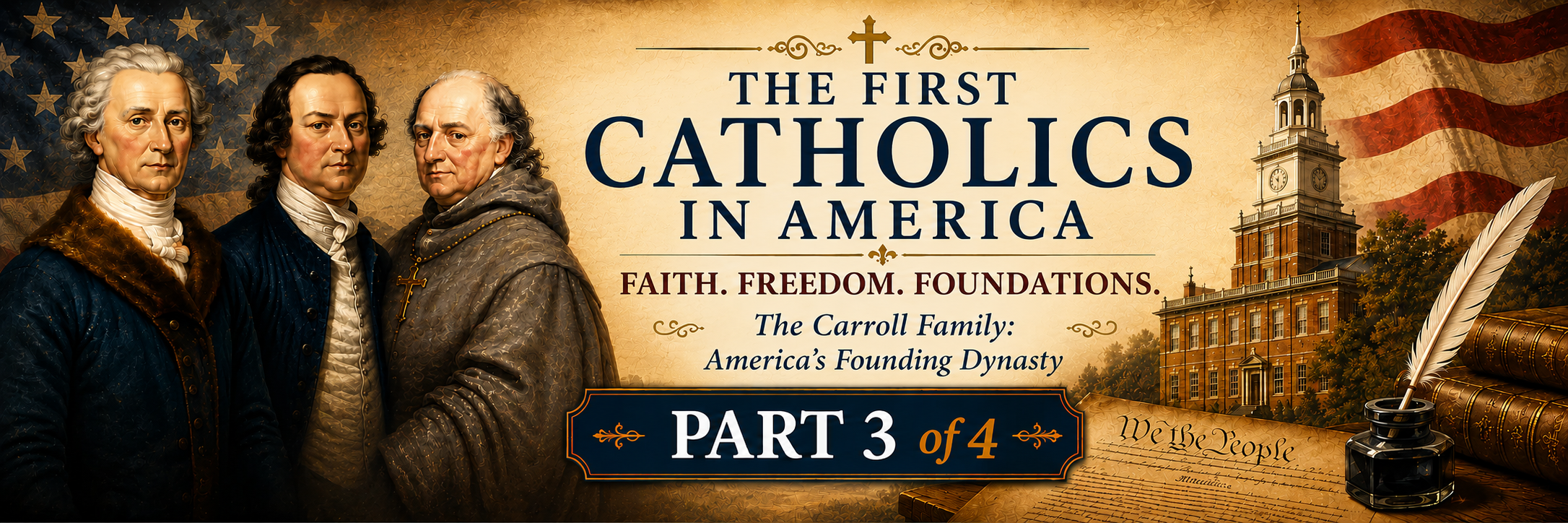
In our next article, we'll explore how the Carroll family of Maryland became one of the most influential Catholic families in American history and helped shape the nation's founding.
[[st-michael-america-brave-beads-tenner, america250™-eagle-flag]]
Read Next: The First Catholics in America, Part 3 -The Carroll Family: America's Catholic Founding Dynasty
Read Next: The First Catholics in America, Part 4 - Thomas Fitzsimons: The Forgotten Catholic Founding Father