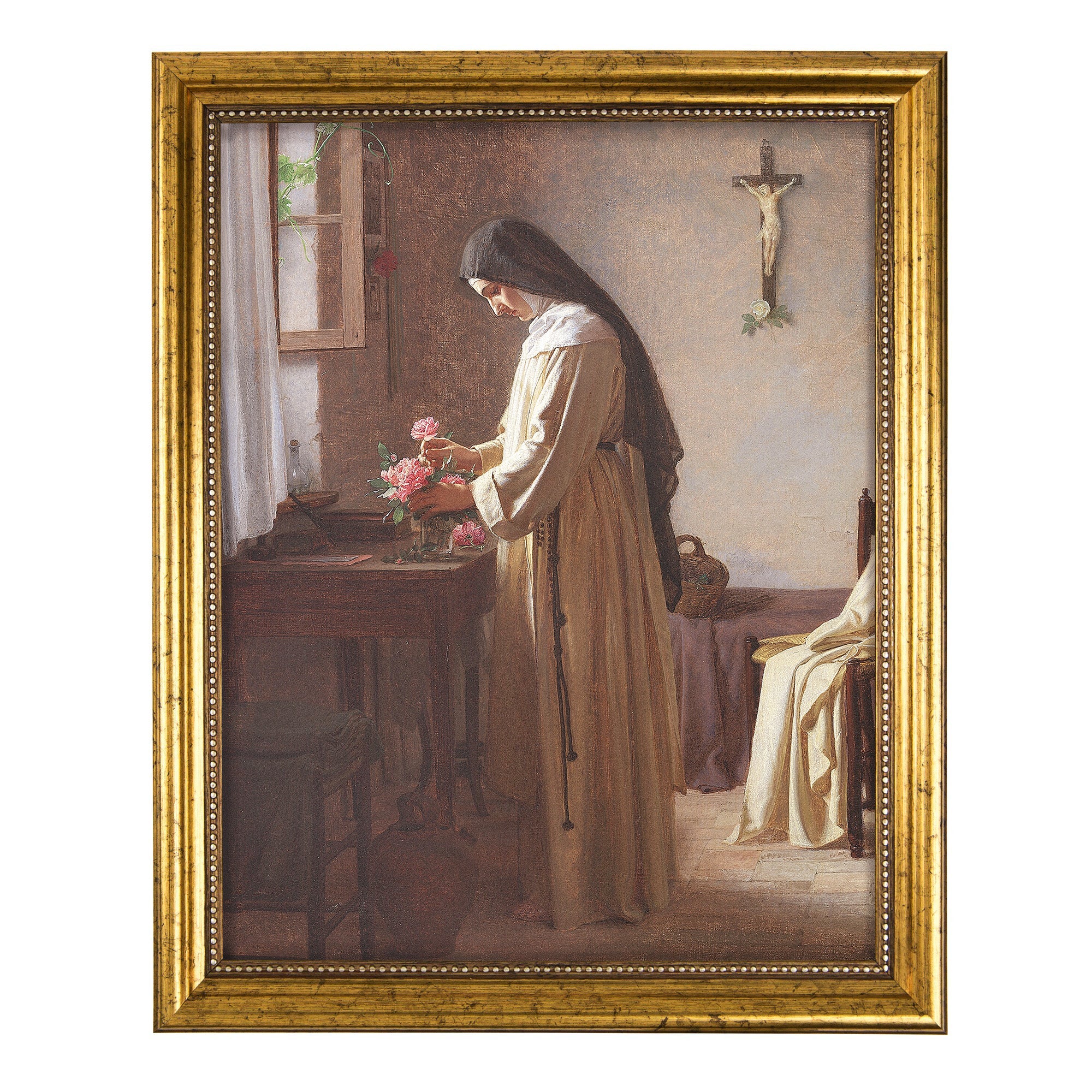
There’s a sweet miracle that you should know about…
Did you know some saints had a miraculously sweet-smelling fragrance?
Yes! It’s sometimes called the “odor of sanctity” that emanates from them, often even after death. It’s almost as if their holiness and friendship with God radiates from them through a sweet fragrance.
Let’s meet some of these sweet-smelling saints…
St. Therese of Lisieux: After her death in 1897, many reported that her grave and relics emitted a beautiful floral scent, even before her body was exhumed during her beatification process. This fragrance was experienced by those who prayed for her intercession and has been noted in connection with her relics to this day.

St. Padre Pio: Witnesses reported that he exuded a perfume-like smell, often described as a blend of flowers and incense. This occurred even during his lifetime and was experienced by people in his presence or praying to him from afar.
St. Rita of Cascia: Her incorrupt body, preserved in a glass coffin in Italy, is said to emit a subtle, sweet aroma. Visitors to her shrine often comment on this unexpected fragrance, which has persisted for centuries.
St. Catherine of Siena: After St. Catherine’s death in 1380, witnesses noted that a pleasant, floral-like scent was present around her body, particularly during her funeral and burial. This phenomenon was recorded by contemporaries and later hagiographers and was understood as a sign of holiness rather than a physical explanation. Similar reports appear in the lives of other saints, such as St. Thérèse of Lisieux and St. Teresa of Avila.
In Catholic tradition, the odor of sanctity is not considered miraculous proof of sainthood on its own. Rather, it is viewed as a spiritual sign sometimes accompanying a life of heroic virtue. The Church never bases canonization on such phenomena, but it does acknowledge them when they are well attested.
In St. Catherine’s case, the fragrance was associated with her intense life of prayer, penance, and mystical union with Christ. Her body was later found to be partially incorrupt, with her head remaining remarkably preserved, now venerated in Siena.
The Church views the odor of sanctity as a sign, not proof, of sainthood. It’s never the sole reason for canonization. For those saints whose lives bore the fragrance of virtue, it seems fitting that their earthly remains would bear the fragrance of heaven.
Although we may not possess this miraculous fragrance, we can use a sweet scent to help cultivate a holy and prayerful space with a Catholic candle! One of our favorites is this St. Catherine Set the World on Fire candle. With its elegant design, quote from St. Paul, and delightful citrus, jasmine, and musk scent, this candle is the perfect addition to any Catholic space. Order yours today from The Catholic Company!