If you are like me, the subject of spiritual warfare can feel a little intimidating. I don't question that it's real - Scripture and the Church are clear about that. What I've never been sure of is how to approach it. Some days I think about the devil too much; other days I forget there's a battle going on at all.
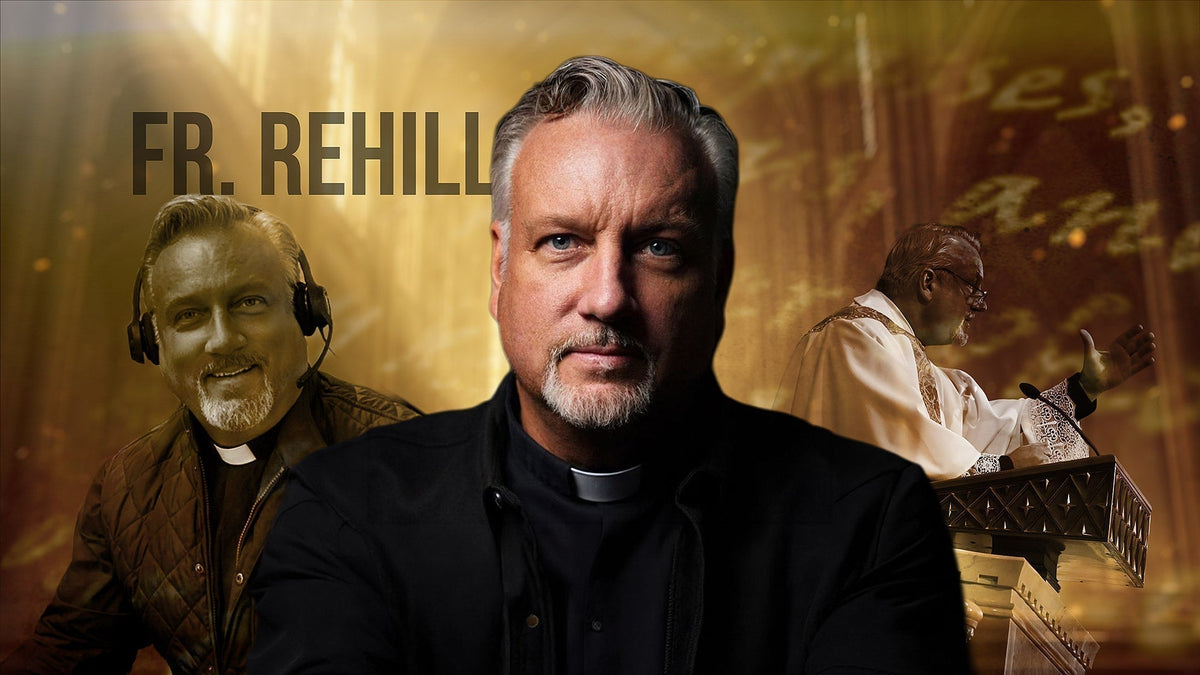
That's one of the reasons I was grateful to speak with Fr. Dan Reehil, pastor of St. Catherine of Siena Church in Columbia, TN, exorcist for the Diocese of Nashville, and National Director for Radio Maria USA.
His ministry has brought him face to face with the demonic. What struck me most was his peace.
He is glad, he told me, that people talk more about spiritual warfare today than they used to. But it should never become a fascination with the demonic. Again and again he pointed back to the ordinary means of grace every Catholic already has: the Sacraments, prayer, the sacramentals, and a faithful Catholic life. His message was simple: don't become preoccupied with the devil. Stay close to Jesus.
For spiritual warfare products, visit our Fr. Reehil's Spiritual Warfare Collection at The Catholic Company today.
Here is what he told me to do:
1. Stay in a state of grace - go to Confession.
"The Sacraments are our supply lines—cut them and we starve; keep them open and hell trembles."
The first line of defense isn't a sacramental. It's the Sacraments. Frequent Confession and the worthy reception of the Eucharist unite us to Christ and close the doors that sin opens — and sin is the door the enemy uses.
Confession is the one Fr. Dan pressed hardest. We stay away for every reason: it's been too long, we're too busy, we simply don't think about it — which is precisely what the devil would prefer. Whatever has kept you from the Sacrament of Penance, remember his warning: “The devil's favorite lie is that our sins are either too small to bother with or too great to be forgiven.”
2. Live a disciplined spiritual life.
“I wish we understood the power we all have — prayer, the Sacraments, our guardian angels, the Holy Spirit given to us at Baptism… Jesus has stacked the deck in our favor, but we have to engage these gifts.”
Spiritual warfare, Fr. Dan insists, is not primarily about reacting to the devil. It is about growing closer to Christ. Daily prayer, Mass, Scripture, time before the Blessed Sacrament, fasting, and plain perseverance in ordinary Christian discipline leave the enemy very little room to work..
It helps to know the enemy's limits. The devil cannot read your mind and cannot control it. He can suggest — a thought, an image, a temptation — and you are always free to refuse. We are the gatekeepers of our own thoughts.
That is also why what we feed our minds matters. Fr. Dan named three things he calls the devil's “calling card”: division, nudity, and violence. Look at much of what is on offer online, on television, and in theaters, and you'll see how ordinary all three have become. The more we fill our minds with what leads away from Christ, the harder it is to recognize His voice. Choosing what is good, true, and beautiful is not a lifestyle preference. It is part of the battle.
3. Pray the Rosary every day.
The Rosary came up again and again. Our Lady has been the enemy of satan since Genesis — “I will put enmity between you and the woman” (Gen 3:15) — and daily fidelity to the Rosary strengthens both individuals and families in the fight. Padre Pio called it “the weapon.” Fr. Dan says: use it as one.
What he told me about her role in his own ministry amazed me. Every exorcism is performed solely in the name and authority of Jesus Christ; Christ alone has power over evil. Yet demons react to Mary. People undergoing an exorcism have cried out, “She's here!” — and then the demon flees.
He told me another story, smaller but no less telling. A group of nuns were together in a room when a very large, very aggressive raccoon tried to come in through the window. Nothing they threw at it drove it off, and the situation grew frightening. So they prayed — the Magnificat, Mary's own prayer. The animal fled — as if boiling water had been thrown on it.
The devil fears the one creature who most perfectly said “yes” to God. If a full Rosary isn't possible today, pray a decade. Pray it with your family if you can.
[[miraculous-medal-rosary-with-blue-enamel-box,gunmetal-st-benedict-paracord-rosary-multiple-colors]]
4. Make holy water part of your daily routine
"Bless your home. Bless your family. Sprinkle your bedroom with holy water before sleep."
Holy water isn't magic. It is one of the Church's great sacramentals — a reminder of your Baptism and a prayer for God's protection. Many Catholics keep a font by the door and sprinkle their bedrooms before sleep. Fr. Dan sprinkles his airplane seat before he sits in it, and the car before a long drive.
Two cautions: never cling to it out of fear, and never use it superstitiously. Used with faith, holy water expresses confidence in God — and becomes a daily reminder that the Lord's protection is constant.
[[gold-white-holy-water-spritzer-bottle,white-holy-family-holy-water-font]]
5. Don't forget blessed salt
Blessed salt is another sacramental the Church has used for centuries, and Fr. Dan's recommendation is remarkably simple: cook with it. It is an easy way to bring the Church's blessing into ordinary family life.
As with every sacramental, its power comes not from the salt but through the blessing of the Church and the faith of the one who uses it. Your parish can bless water and salt for your home — just ask — and many parishes bless both in a special way around the Feast of the Epiphany.
6. Bless your home
Our homes should be places where Christ is welcome. Fr. Dan encourages families to have their home blessed by a priest, and then to keep praying in it — using sacramentals as reminders that the house belongs to God. The blessing matters, he said, but not as much as the daily prayer life of the people who live there.
You can bless your home and family yourself with holy water. At Epiphany, follow the old custom of blessed chalk: mark the doorway with the year and the letters C + M + B — 20 + C + M + B + 26 — which stand for the traditional names of the Magi, Caspar, Melchior, and Balthasar, and for the Latin Christus mansionem benedicat: “May Christ bless this house.” And it is always good to ask a priest to come and bless the home formally, invoking the Church's blessing upon it.
[[home-blessing-st-benedict-1,st-benedict-decade-rosary-door-blessing]]
7. Wear blessed sacramentals-with faith
"It all goes back to faith. If you don’t have any faith, these things aren’t going to work.”
A blessed crucifix, a Miraculous Medal, a Brown Scapular — these are more than jewelry. They keep us mindful of Christ, invite us to live the faith deliberately, and quietly witness to it.
But they are not charms, and Fr. Dan's line above deserves a precise reading. The Sacraments act by Christ's own power; sacramentals dispose us to receive grace through the prayer of the Church and the faith of the person using them (CCC 1667–1670). A medal worn without faith is a piece of metal. Worn with faith, it is a prayer you carry.
The Brown Scapular is a good example. People imagine it as a good-luck charm, or as something with a long list of rules. In fact it is the outward sign of enrollment in the Carmelite family and of an inward commitment: to belong to Our Lady, imitate her virtues, and grow closer to Christ. The Miraculous Medal, given through Our Lady to St. Catherine Labouré, inspires trust in her intercession and confidence in God's grace.
Read about the Miraculous Medal and other Catholic medals.
[[wool-brown-scapular-with-our-lady-of-mt-carmel-sacred-heart-st-benedict-14-cord,miraculous-medals-bulk-pack-of-25]]
8. Remember: sacramentals point us to Christ
Fr. Dan's most important reminder — he made it several times — is that sacramentals are never lucky charms. Their power comes through the prayer of the Church and the faith of the person using them, which is exactly why the devil hates them. They reveal our faith, dispose us to receive God's grace, and keep turning our attention back to Jesus Christ.
Holy water, blessed salt, a medal, a rosary, a scapular: all of them bring the life of the Church into the home. Used with faith rather than superstition or fear, they become daily reminders that Christ is with us always, and that His grace is available in the ordinary moments of our lives.
Everyday spiritual warfare is exactly that: everyday. But if a disturbance persists or worsens despite prayer and the Sacraments, do not diagnose it yourself, and do not attempt exorcism or “deliverance” prayers on yourself or anyone else. Talk to your pastor. He will discern what is going on, and if more is needed, he knows whom to call. Solemn exorcism is celebrated only by a priest with the bishop's permission — and lay-led deliverance outside the Church's structure can deepen the very problem it means to solve.
For more spiritual warfare products, visit Fr. Reehil's Spiritual Warfare Collection
at The Catholic Company.