
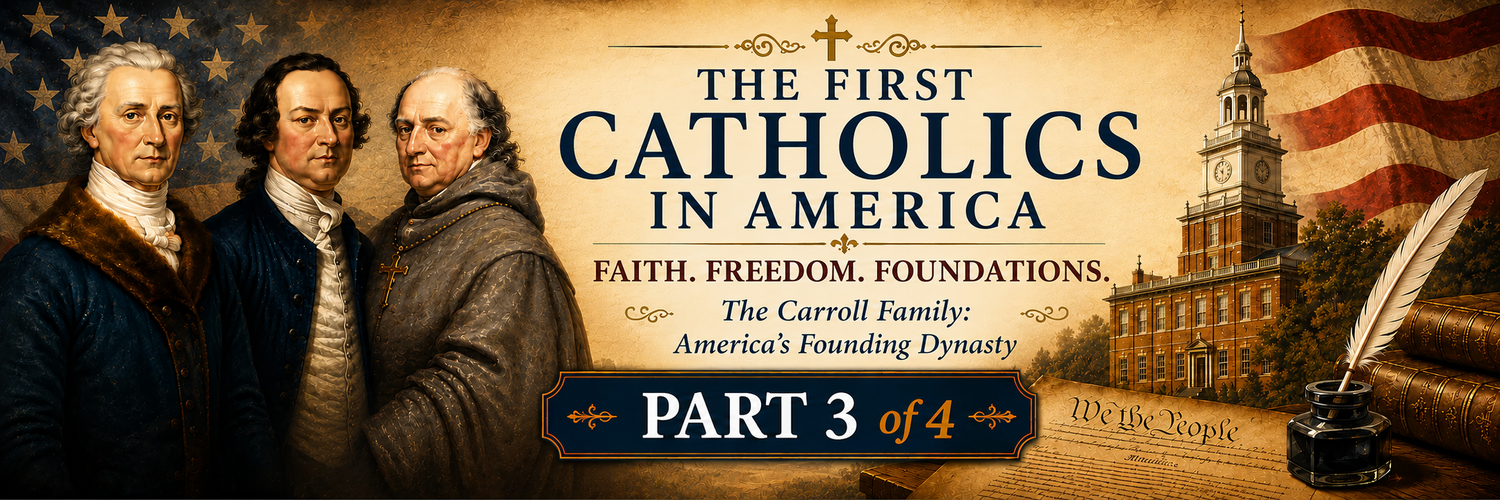
As we prepare to celebrate America's 250th birthday, many of us will revisit the familiar stories of our most familiar Founding Fathers, but in addition to these men, there were also lesser known Catholics who helped shape our nation. One of the most remarkable founding families remains largely unknown outside Catholic and historical circles.
The Carroll family of Maryland produced a signer of the Declaration of Independence, a signer of the Constitution, America's first Catholic bishop, and leaders who helped shape the nation's capital.
Their incredible story is not only a Catholic story. It's an American story of influential Catholic men who were able to prosper because of the founding of Maryland by Catholics, and the Religious Toleration Act.
Catholics in Colonial America
To understand the Carrolls, we must first understand the world in which they lived. Catholics in colonial America often faced legal restrictions and social suspicion. In many colonies they could not hold public office, vote freely, or openly practice their Faith.
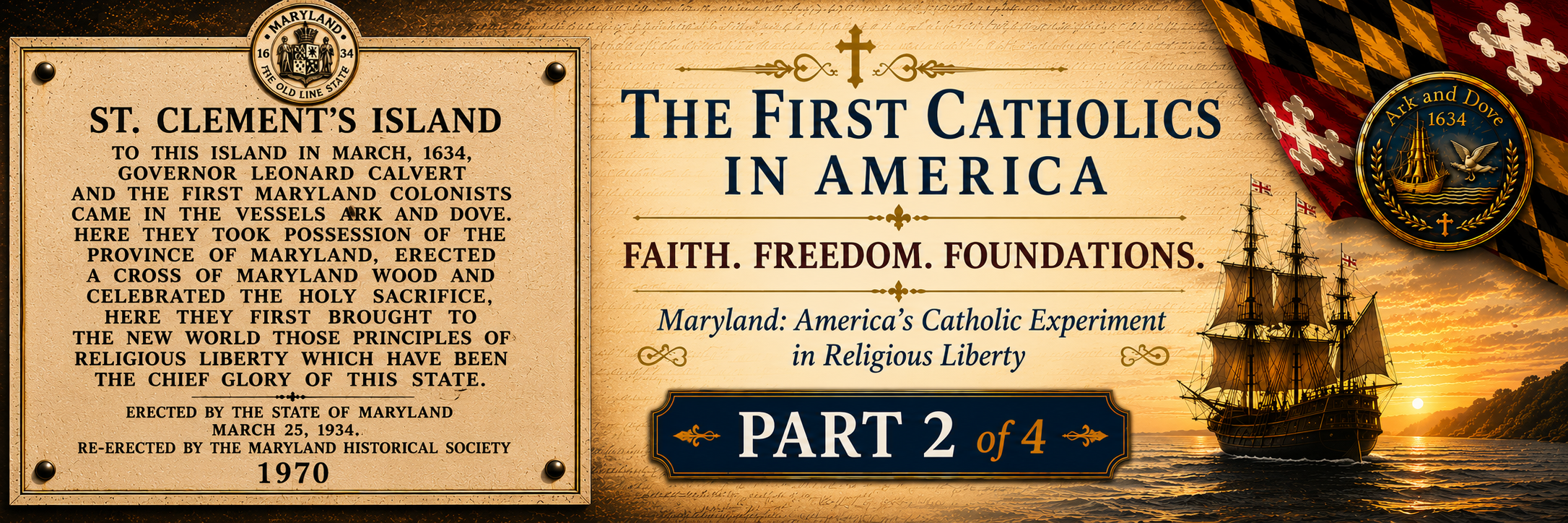
Anti-Catholic prejudice was inherited from centuries of conflict in England, and remained strong throughout much of the colonial period. Maryland was different. Founded in 1634 by the Catholic Calvert family, Maryland became one of the first places in the English-speaking world to experiment with religious tolerance.
Although religious conflicts later reduced many of those protections, Maryland remained home to a very substantial Catholic community.
Among the Catholic families that flourished there were the Carrolls, whose faith, leadership, and patriotism would leave an indelible mark on the founding of the United States.
Charles Carroll of Carrollton: Signer of the Declaration
Charles Carroll of Carrollton remains the most famous Catholic Founding Father of our nation. Educated in Europe because Catholics faced educational barriers in the colonies, Carroll returned to Maryland with extensive training in law, philosophy, and political thought.
He became one of the wealthiest men in America, but also one of its strongest advocates for independence. When the Continental Congress adopted the Declaration of Independence in 1776, Charles Carroll became the only Catholic signer.
His signature represented a tremendous personal risk. If the Revolution failed, he stood to lose his fortune, his lands, and possibly his life.
Legend holds that he signed "Charles Carroll of Carrollton" rather than simply "Charles Carroll" because there were several prominent men with the same name. By adding "of Carrollton," he made clear exactly who was taking responsibility for supporting independence.
This faithful Catholic later served in the Maryland Senate, the Continental Congress, and the first United States Senate. He outlived every other signer of the Declaration and became a living link to the nation's founding.
[[/charles-carrol-of-carrollton-american-revolutionary,prayer-of-george-washington-america250™-commemorative-print-8-x-10]]
Daniel Carroll: Signer of the Constitution
Charles Carroll was not the family's only contribution to the new nation. His cousin Daniel Carroll served as a delegate to the Constitutional Convention in Philadelphia and became one of the few men to sign both the Articles of Confederation and the United States Constitution.
Daniel strongly supported the Constitution and worked for its ratification. He later became one of the first members of the U.S. House of Representatives. His contributions extended beyond government service. Daniel Carroll owned substantial land near the Potomac River and helped facilitate the creation of the federal district that would become Washington, D.C.
The land donated by local property owners, including the Carroll family and related landholders, formed part of the territory from which the nation's capital emerged. Through those efforts, the Carrolls helped provide a permanent home for the federal government.
[[one-nation-under-god-250th-anniversary-yard-sign,there-is-no-greater-love-garden-flag]]
John Carroll: America's First Catholic Bishop
Perhaps the most enduring legacy of the family came through John Carroll, brother of Daniel Carroll. In 1789, Pope Pius VI appointed John Carroll as the first Catholic bishop in the United States. He became a key figure in establishing the Catholic Church within the new republic.
Unlike many European nations, America would have no established national church. John Carroll embraced this arrangement and saw religious freedom as an opportunity rather than a threat.
He cultivated positive relationships with national leaders, including George Washington. Washington frequently expressed support for religious liberty and welcomed Catholic participation in the life of the nation.
John Carroll also founded Georgetown University in 1789, making it the first and oldest Catholic university in the United States. More than two centuries later, Georgetown remains one of the nation's most influential educational institutions.
[[god-bless-america-scriptures-devotions-prayers-for-our-nation,american-saints-book-of-prayers]]
A Catholic Contribution to American Freedom
The Carroll family's story reveals an important truth about the American founding:
Catholics were active architects of our republic.
Charles Carroll risked his fortune and life by signing the Declaration of Independence. Daniel Carroll helped frame and ratify the Constitution while contributing land and expertise to the development of our capital. Bishop John Carroll built the foundations of the Catholic Church in America, and helped demonstrate that religious faith and republican government could flourish together.
Their achievements helped prove that American citizenship would not depend upon belonging to a particular denomination.
Lessons for America's 250th Anniversary
As the nation approaches its 250th anniversary, the Carroll family reminds us that America's founding was strengthened by citizens of different backgrounds who could unite around common principles.
The founders did not all share the same theological views, but many shared a conviction that freedom was a gift entrusted by God and that human rights did not come from government alone.
The Carrolls brought their Catholic faith into public service while helping establish a nation committed to religious liberty for all. Their legacy stands as a reminder that faith and freedom have long been partners in our American story, and that faithful Catholics helped shape our nation from the very beginning.
[[red-white-blue-america-250th-anniversary-commemorative-glass-rosary,faith-family-freedom-canvas-tote]]
Read Next: How to Support Military Families: A Catholic Guide to Faith & Encouragement